Closing the Formulation Gap: The Business Value of Constructing Missing SAP PLM Data for Food & Beverage Digital Threads
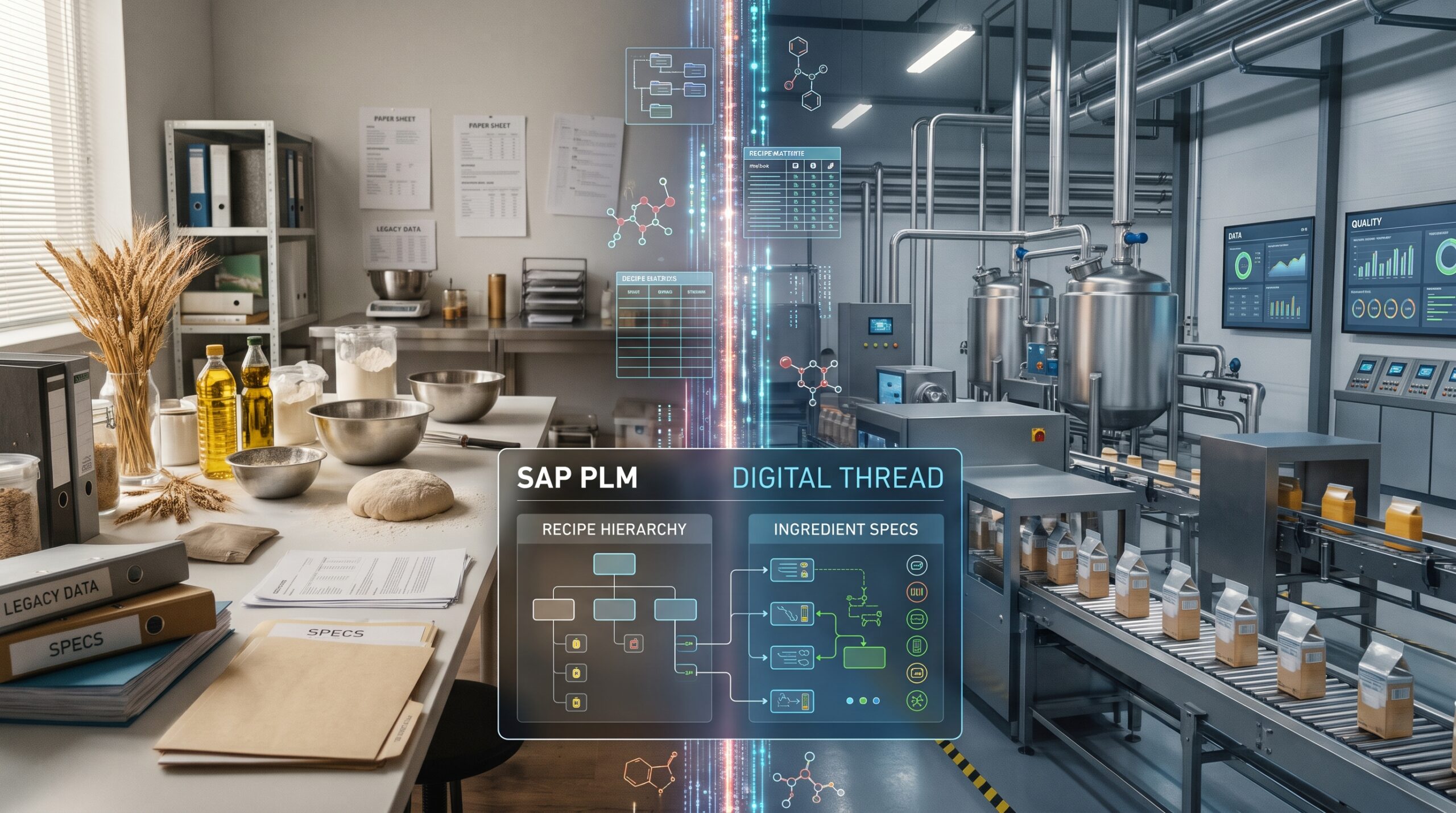
For many Food and Beverage (F&B) manufacturers, the enterprise digital thread breaks right between the R&D benchtop and the manufacturing floor. While companies invest heavily in SAP S/4HANA, Manufacturing Execution Systems (MES), and Integrated Business Planning (IBP), the upstream product data feeding those platforms is frequently incomplete.
During legacy ERP upgrades or rapid M&A integrations, organizations routinely migrate only the bare minimum required to keep plants running: finished good material masters, flat Manufacturing Bills of Materials (MBOMs), and basic purchasing info records. Meanwhile, the foundational Product Lifecycle Management (PLM) data, including structured ingredient specifications, multilevel subrecipe hierarchies, allergen profiles, process loss factors, and packaging attributes, remains trapped in supplier PDFs, lab notebooks, and disconnected Excel spreadsheets.
Constructing this missing SAP PLM data is often mischaracterized as a back office IT cleanup exercise. In reality, bridging the upstream data gap unlocks substantial commercial, operational, and risk reduction value across the entire F&B value chain.
Where the Digital Thread Breaks in Food & Beverage
Unlike discrete manufacturing, where a mechanical assembly is defined by rigid geometric tolerances, F&B products are governed by biological variability, chemical interactions, and strict regulatory thresholds. When upstream SAP PLM objects are missing or unpopulated, critical blind spots emerge across enterprise systems:
- Flat ERP BOMs Without Recipe Intelligence: ERP systems typically store a single level list of raw materials needed to produce a batch. Without structured SAP Recipe Development (RD) objects, the system loses visibility into intermediate subrecipes, ingredient functionality (e.g., emulsifier vs. stabilizer), and stage by stage yield losses such as moisture evaporation or bake loss.
- Unstructured Supplier Specifications: Certificates of Analysis (COAs), nutritional breakdowns, religious certifications (Kosher and Halal), and country of origin declarations often sit as static PDF attachments. Because they are not modeled as structured property trees in SAP Specification Management, downstream systems cannot query or aggregate them automatically.
- Disconnected Packaging and Labeling Data: Primary, secondary, and tertiary packaging specifications frequently live outside the core product structure, severing the link between formula changes, FDA Nutrition Facts panels, ingredient declaration statements, and artwork approvals.
- Siloed Plant Level Execution: Without a harmonized transformation from R&D primary recipes to plant specific Master Recipes and Production Versions, individual factories maintain localized workarounds, leading to standard cost variances and inconsistent product quality across sites.
Quantifying the Business Value of Complete SAP PLM Data
Reconstructing missing PLM data transforms disconnected documents into a computable, item centric digital thread. When ingredient specifications, formulas, and process parameters are natively connected in SAP PLM, F&B enterprises capture measurable business value across five core areas:
| Business Function | Fragmented State (Missing PLM Data) | Connected State (Constructed SAP PLM Data) | Measurable Business Value |
| R&D & Reformulation | Weeks of manual spreadsheet cross checking to assess an ingredient change across SKUs | Instant “where used” impact analysis across multilevel recipes and specifications | 50 to 70% faster reformulation cycles during supply shortages or cost spikes |
| Regulatory & Quality | Manual nutrient calculations and static allergen spreadsheets prone to human error | Automated dynamic rollups of nutrients, allergens, and claims via SAP PLM & EHS | Eliminates Class I undeclared allergen recalls and accelerates global label approvals |
| Strategic Procurement | Duplicate raw material specs across plants; slow qualification of alternate suppliers | Standardized specification trees linked to Approved Manufacturer Lists (AMLs) | 3 to 8% raw material cost savings through ingredient consolidation and competitive bidding |
| Manufacturing & Finance | Inaccurate standard costs due to unmodeled evaporation, trim, and batch yield losses | Synchronized R&D to ERP Master Recipes with explicit process loss and yield logic | Tighter gross margin control and reduced scrap and batch rework on the shop floor |
| Supply Chain & ESG | Manual supplier surveys for FSMA 204 traceability and Scope 3 emissions reporting | Granular lot genealogy, origin, and carbon footprint attributes embedded in specs | Audit ready compliance and automated Scope 3 reporting at the SKU level |
1. Compressing Time to Market and Reformulation Agility
Commodity price volatility, climate disruptions, and shifting consumer preferences (such as sugar reduction or clean label mandates) force F&B teams to reformulate constantly. When cocoa, vanilla, or high oleic oil prices spike, R&D teams with complete SAP PLM data can query every affected recipe across global brands in seconds, simulate alternative ingredient ratios, and evaluate cost and sensory impacts before running a single pilot batch.
2. Eliminating High Cost Regulatory and Recall Exposure
Undeclared allergens remain the leading cause of FDA food recalls, often triggered when a supplier modifies a minor subingredient and the downstream impact is missed in manual spreadsheets. By structuring raw material allergen and nutritional properties inside SAP Specification Management, automated rollup engines immediately flag if a raw material update introduces a new allergen or invalidates a front of pack claim (such as “Gluten Free” or “Low Sodium”).
3. Unlocking Procurement Leverage and Raw Material Rationalization
Across multiplant F&B enterprises, it is common to find five different material numbers for identical granulated sugar or citric acid, each tied to localized supplier agreements. Reconstructing standardized ingredient specifications exposes functional equivalents across business units, empowering procurement teams to consolidate spend, qualify secondary suppliers rapidly, and mitigate single source supply chain bottlenecks.
4. Enabling AI Driven Recipe Optimization and Digital Twins
Modern AI initiatives, such as predictive should cost modeling, automated formula optimization, and digital process twins, cannot run on unstructured PDFs or incomplete ERP BOMs. Constructing clean, schema grounded SAP PLM data creates the machine readable foundation required for AI models to balance ingredient costs, nutritional targets, and processing constraints simultaneously.
A Practical Blueprint for Constructing Missing PLM Data
Rebuilding historical product data does not require halting new product development or launching a multiyear manual data entry campaign. F&B leaders can close the gap systematically through four pragmatic steps:
- Prioritize by Revenue and Supply Risk (The 80/20 Rule): Focus initial data reconstruction on the top 20% of core raw materials, base subrecipes, and high volume finished SKUs that generate 80% of revenue or carry the highest regulatory and allergen risk. Archive dormant or low volume legacy SKUs rather than overengineering historical cleanup.
- Use Schema Grounded Extraction for Supplier Documents: Instead of keying thousands of supplier spec sheets and COAs by hand, deploy schema grounded AI extraction pipelines mapped directly to your SAP Specification Management property trees. Pair automated extraction with human in the loop quality gates so food technologists and regulatory specialists only review low confidence fields.
- Reconnect Recipe Hierarchies and Yield Logic: Reverse engineer flat ERP BOMs back into multilevel SAP Recipe Development structures. Capture critical intermediate streams, moisture and fat loss factors, and equipment specific process parameters so R&D formulas reconcile cleanly with plant floor Master Recipes.
- Lock In Governance with Closed Loop Change Management: Once missing specifications and recipes are constructed, enforce strict governance through SAP Engineering Change Management (ECM). Require all new raw material onboarding, supplier changes, and packaging updates to originate in SAP PLM so the organization never reverts to offline spreadsheets.
Turning Master Data into a Competitive Moat
In an industry defined by tight operating margins, complex global supply networks, and zero tolerance food safety standards, master data completeness is a direct driver of financial performance. Constructing the missing links in SAP PLM transforms R&D knowledge from tribal memory into a scalable corporate asset, giving Food and Beverage companies the speed to innovate, the precision to protect margins, and the traceability to lead in an increasingly regulated market.