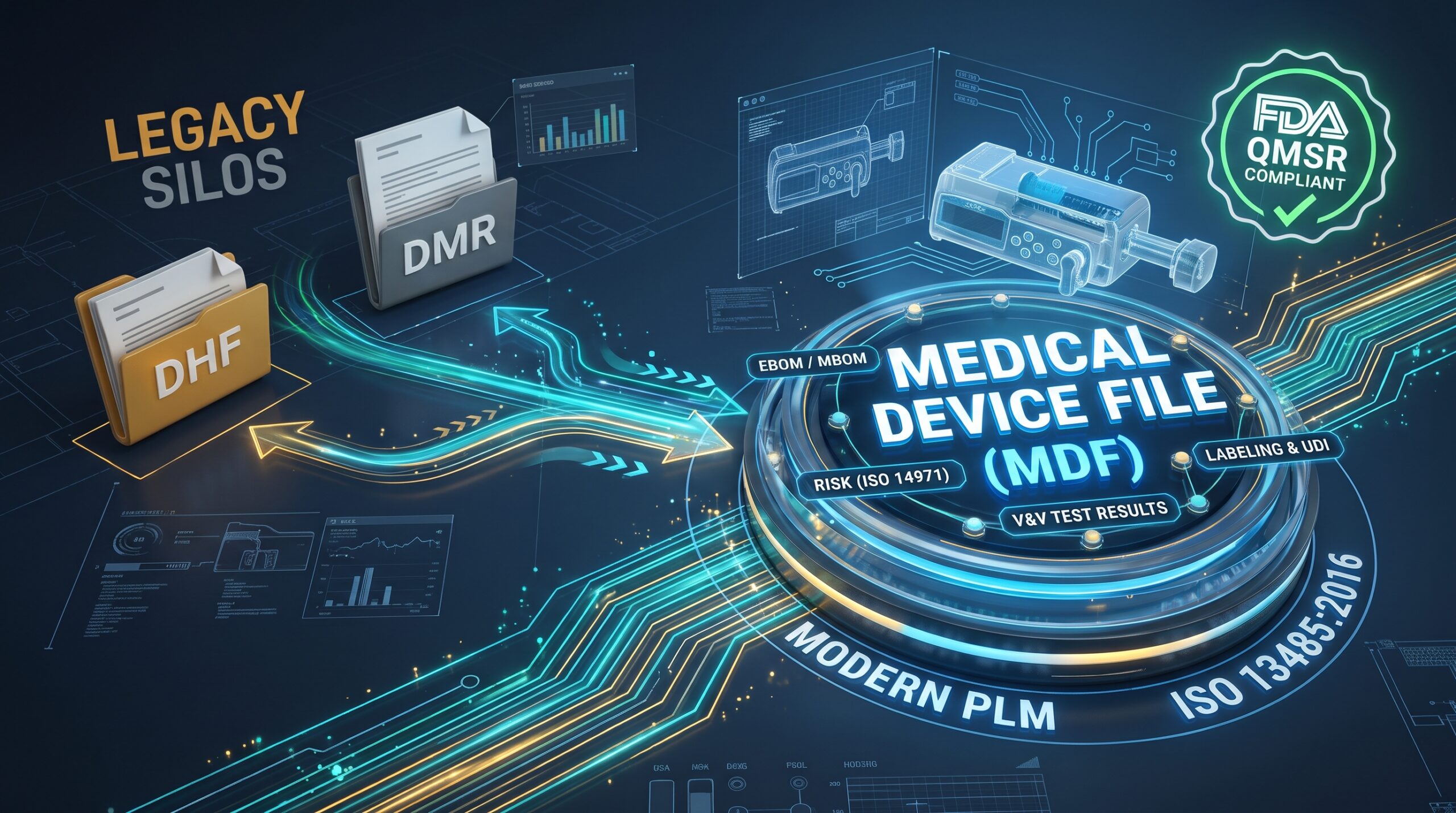
Navigating FDA QMSR Compliance: Structuring the Medical Device File (MDF) in Modern PLM
Since the FDA Quality Management System Regulation (QMSR) took effect on February 2, 2026, medical device manufacturers operating in the U.S. market have transitioned from the legacy 1996 Quality System Regulation (QSR) to a harmonized framework that incorporates ISO 13485:2016 and Clause 3 of ISO 9000:2015 by reference. Alongside this regulatory shift, the FDA retired the Quality System Inspection Technique (QSIT) in favor of Compliance Program 7382.850, ushering in lifecycle-focused, risk-based inspections.
For medtech engineering and quality teams, the most immediate architectural consequence is the consolidation of legacy record silos. Under QMSR, standalone FDA terms like Design History File (DHF), Device Master Record (DMR), and Device History Record (DHR) are replaced by ISO 13485:2016 documentation structures-centered on the Medical Device File (MDF) under Clause 4.2.3 and the Design and Development File under Clause 7.3.10.
Treating this transition as a simple document-renaming exercise creates severe audit exposure. When design history lives in shared network drives, manufacturing specifications reside in ERP, and risk matrices sit in disconnected spreadsheets, engineering teams struggle to prove end-to-end traceability. Modern Product Lifecycle Management (PLM) platforms solve this by transforming the MDF from a static folder of PDFs into a live, item-centric digital thread.
The Regulatory Shift: From Siloed DHF and DMR to a Unified MDF
The QMSR final rule did not eliminate the substantive documentation requirements of the legacy QSR; instead, it mapped them directly onto international ISO 13485:2016 clauses while retaining targeted FDA-specific controls. Additionally, QMSR eliminated the legacy 21 CFR 820.180(c) inspection exemption, meaning management review records, internal quality audits, and supplier audit reports are now open to FDA investigator review.
Understanding how legacy records map into modern PLM objects is the foundation of an audit-ready architecture:
| Legacy 21 CFR 820 (QSR) | QMSR / ISO 13485:2016 Equivalent | Modern PLM Architectural Representation |
| Design History File (DHF) (21 CFR 820.30(j)) | Design and Development File (ISO 13485 Clause 7.3.10) | Relational traceability graph linking Requirements, Risk Controls, CAD Models, Verification and Validation (V&V) protocols, and design review sign-offs |
| Device Master Record (DMR) (21 CFR 820.181) | Medical Device File (MDF) (ISO 13485 Clause 4.2.3) | Top-level Finished Device Item Revision housing the Engineering BOM (EBOM), Manufacturing BOM (MBOM), Approved Manufacturer List (AML), test procedures, and packaging/labeling specs |
| Device History Record (DHR) (21 CFR 820.184) | Production & Traceability Records (ISO 13485 Clauses 4.2.3, 7.5.1, 7.5.9 & 21 CFR 820.35) | As-built serial/lot genealogy synced between PLM, MES, and ERP, tied to exact released MDF revision baselines |
| Labeling & Packaging Controls (21 CFR 820.120 / 820.130) | Device Labeling & Packaging Controls (21 CFR 820.45 & ISO 13485 Clause 4.2.3) | Controlled artwork revisions, Instructions for Use (IFU), and Unique Device Identification (UDI-DI) attributes governed under Engineering Change Orders (ECOs) |
| Complaint & Servicing Files (21 CFR 820.198 / 820.200) | Control of Records & Feedback (21 CFR 820.35 & ISO 13485 Clauses 7.5.4, 8.2.2) | Closed-loop CAPA and Non-Conformance (NCR) objects linked back to affected MDF parts and risk files |
Why Document-Centric QMS Fails Under QMSR
Many medtech organizations rely on document-centric Quality Management Systems (eQMS) that store exported PDFs in hierarchical folders. While functional for SOP management, a file-cabinet approach breaks down under QMSR inspections for three reasons:
- Static Snapshots vs. Live Configuration: When a DMR is maintained as a static Word or PDF index listing drawing numbers and revision levels, every minor component change requires manual document updates. A single missed revision increment creates an immediate discrepancy between the released CAD/BOM baseline and the documented MDF.
- Broken Risk-to-Design Traceability: ISO 13485:2016 embeds risk management across the entire product realization lifecycle rather than isolating it in design validation. If Hazard Analyses and FMEAs live in standalone spreadsheets, proving that a specific design change did not invalidate a mitigation control requires tedious manual cross-checking.
- Siloed Global Submissions: Manufacturers selling in both the U.S. and the EU (under EU MDR) previously maintained parallel compliance binders. Without a unified data model, teams duplicate effort maintaining separate EU Technical Documentation and U.S. DHF/DMR packages for the exact same physical device.
Core PLM Data Architecture for an Audit-Ready MDF
To eliminate manual synchronization and maintain continuous audit readiness, medtech engineering teams should structure their PLM environment-whether built on Siemens Teamcenter, SAP S/4HANA PLM, Dassault Systèmes 3DEXPERIENCE, or Oracle Agile-around five foundational pillars.
1. Item-Centric Finished Device Anchor
Instead of organizing the MDF as a folder tree, anchor the Medical Device File to the Finished Good Item Revision in PLM. Every regulatory artifact-product descriptions, intended use statements, specifications, manufacturing procedures, and servicing manuals required under Clause 4.2.3-attaches directly to that item revision via typed relationships. When a device advances from Revision A to Revision B, PLM automatically baselines the exact configuration of every child specification valid at that release point.
2. Multi-View BOM Synchronization (EBOM, MBOM, and Labeling)
Under Clause 4.2.3, the MDF must encompass complete specifications for product design, manufacturing, packaging, and labeling. Modern PLM handles this through synchronized Bill of Materials views:
- Engineering BOM (EBOM): Driven directly by mechanical, electrical, and embedded software CAD structures, capturing exact component tolerances, material compositions, and biocompatibility specs.
- Manufacturing BOM (MBOM) & Bill of Process (BOP): Links the EBOM to assembly work instructions, cleanroom routing steps, inspection checkpoints, and validated equipment parameters.
- Labeling & Packaging Structure: Treats labels, barcodes, sterilization pouches, and IFUs as controlled BOM items with explicit 21 CFR 820.45 verification attributes and UDI-DI mappings.
3. Relational Traceability Graph (Clause 7.3 & ISO 14971)
Rather than embedding requirements and test results into monolithic documents, model them as granular objects inside PLM:User Need -> Design Input -> Risk Control (ISO 14971) -> Design Output (CAD/Part) -> Verification/Validation Protocol -> V&V Test Result
This object-level traceability enables instant suspect-link flagging. If an engineer modifies a critical component tolerance on a Design Output part, PLM automatically flags upstream Design Inputs, associated FMEA failure modes, and downstream V&V test protocols for re-evaluation.
4. Closed-Loop Engineering Change Management (ECO/ECN)
An Engineering Change Order in PLM serves as the single governance engine bridging Clause 7.3.10 (Design and Development File) and Clause 4.2.3 (MDF). Configure ECO workflows to enforce mandatory impact assessments across:
- Regulatory submission thresholds (evaluating whether a change triggers a 510(k) Letter-to-File or new submission)
- Risk management file updates and residual risk recalculations
- Supplier notification and incoming inspection updates for outsourced components
- Downstream ERP and MES release gates so manufacturing cannot build to an unapproved revision
5. 21 CFR Part 11 Governance and On-Demand Audit Publishing
During an inspection under Compliance Program 7382.850, investigators trace threads from postmarket complaints or CAPAs back through design controls and manufacturing records. PLM systems enforce 21 CFR Part 11 electronic signatures with role-based sign-off matrices (R&D, Quality, Regulatory, Manufacturing) and immutable audit trails. Using automated publishing templates, teams can export a complete, hyperlinked MDF dossier-complete with watermarked drawings, signed V&V reports, and traceability matrices-in minutes rather than days.
A 4-Step Migration Roadmap for MedTech Engineering Teams
Transitioning legacy DHF and DMR repositories into a unified PLM structure does not require halting active R&D programs. Engineering leaders can execute the consolidation in four controlled phases:
- Audit and Rationalize Legacy Artifacts: Map existing DHF and DMR document types against ISO 13485:2016 Clauses 4.2.3 and 7.3.10, plus 21 CFR 820.35 and 820.45. Retire redundant index forms and standardize metadata attributes (device family, risk class, UDI-DI, market authorizations).
- Configure the PLM Object Model and Relationships: Establish standardized item types, BOM views, and traceability link rules in PLM before migrating files. Ensure CAD integrations and ERP/MES connectors pass item revisions and change statuses cleanly.
- Prioritize Active and High-Risk Product Lines: Migrate active Class II and Class III device families first using schema-validated data loads. Legacy, low-risk devices in sustaining mode can remain in read-only archives unless triggered by a major design change or CAPA.
- Validate Workflows and Train Cross-Functional Reviewers: Execute Computer System Validation (CSV) / Computer Software Assurance (CSA) protocols on the unified MDF workflows, training R&D, manufacturing, and quality engineers to review live PLM objects rather than offline document attachments.
Turning Regulatory Alignment into Engineering Velocity
Unifying the Design History File and Device Master Record into a PLM-governed Medical Device File does far more than satisfy FDA QMSR inspections. When design outputs, risk controls, manufacturing instructions, and labeling specifications share a single source of truth, medtech organizations eliminate late-stage DHF remediation sprints, accelerate global regulatory submissions across U.S. and ISO-aligned jurisdictions, and give engineering teams real-time visibility into every product configuration in the field.