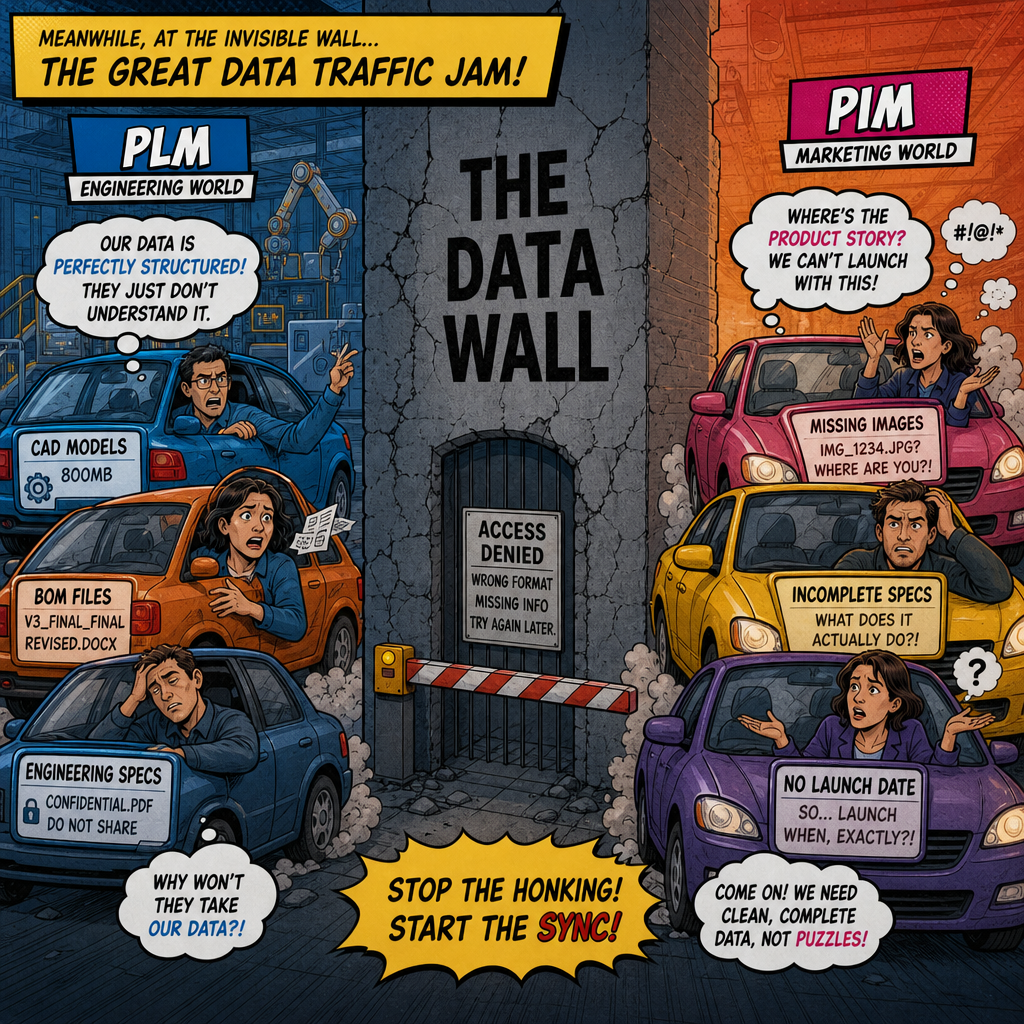
In today’s hyper-connected, omnichannel digital landscape, the speed at which a product moves from the engineering floor to the digital storefront is a critical competitive differentiator. Yet, many organizations are still hampered by an invisible wall separating their engineering data from their marketing data.
In this post, we dive deep into the imperative of 2026: Real-Time Syndication Between Product Lifecycle Management (PLM) and Product Information Management (PIM). We will explore why disjointed product information leads to market delays, the architectural shifts making real-time integration possible, and how closing this gap can revolutionize your digital commerce strategy.
1. The Historical Divide: PLM vs. PIM
For decades, PLM and PIM have operated as isolated silos, serving entirely different stakeholders and objectives.
- PLM (The System of Record for Engineering): PLM focuses on the ideation, design, engineering, and manufacturing of a product. It speaks the language of CAD files, Bill of Materials (BOM), tolerances, compliance documents, and supply chain logistics.
- PIM (The System of Record for Commerce): PIM is built for marketing, sales, and e-commerce. It speaks the language of SKUs, digital assets, SEO descriptions, localized translations, and customer-facing specifications.
Historically, passing data from PLM to PIM was a manual, sequential, or batch-driven process. Engineers would finalize a product, lock the design, and export flat files (like CSVs or Excel spreadsheets). Marketing teams would then ingest this data into the PIM, manually translating engineering jargon into compelling commercial copy.
This batch-driven approach created a latency window that could span weeks or months. If an engineering change order (ECO) occurred late in the cycle, updating the PIM was chaotic, often resulting in customers purchasing products with outdated specifications.
2. The Business Case for Real-Time Syndication
The modern consumer demands total accuracy. If a buyer configures a complex piece of industrial machinery or a smart consumer device online, they expect the technical specifications, weight, dimensions, and sustainability metrics to be flawless.
Real-time syndication means that the moment a product attribute is updated and approved in the PLM, that data event propagates instantly to the PIM, which then updates the downstream e-commerce platforms.
The Cost of Disconnected Systems
- Delayed Time-to-Market (TTM): Manual data entry and reconciliation add weeks to a product launch.
- Data Discrepancies: Disconnected data models lead to mismatched specs, increasing return rates and damaging brand trust.
- Wasted Resources: Highly paid engineers and marketers spend hours validating data rather than focusing on innovation and strategy.
Table 1: Batch Processing vs. Real-Time Syndication
| Feature / Capability | Traditional Batch Processing (Legacy) | Real-Time Syndication (Modern API-First) |
| Data Flow | Scheduled pulls (e.g., nightly/weekly) | Instantaneous event-driven pushes |
| Time-to-Market | High latency (Days/Weeks delay) | Minimal latency (Seconds/Minutes) |
| Error Handling | Post-batch error logs requiring manual fix | Real-time validation and localized rollbacks |
| Agility to ECOs | Very low; requires complete data re-entry | High; delta-changes automatically sync |
| Architecture | Flat file exports, Point-to-Point FTP | Microservices, REST/GraphQL APIs, Webhooks |
3. Architectural Shifts Enabling the Modern Integration
The transition to real-time syndication is driven by the shift from monolithic, on-premise architectures to composable, cloud-native SaaS models. The following technologies are the foundation of this bridge:
A. Event-Driven Architecture (EDA)
Rather than a PIM system constantly querying the PLM for updates (which consumes massive API bandwidth), modern integrations rely on an event-driven model. When a state changes in the PLM (e.g., an item shifts from “In Design” to “Released to Manufacturing”), the PLM emits a webhook or an event to an event bus (like Apache Kafka or AWS EventBridge).
B. Middleware and iPaaS
Integration Platform as a Service (iPaaS) solutions act as the translation layer between PLM and PIM. They catch the events, map the complex nested engineering structures into flat or e-commerce-friendly formats, and push them into the PIM via RESTful APIs.
Graph 1: Event-Driven PLM to PIM Data Flow (System Architecture)
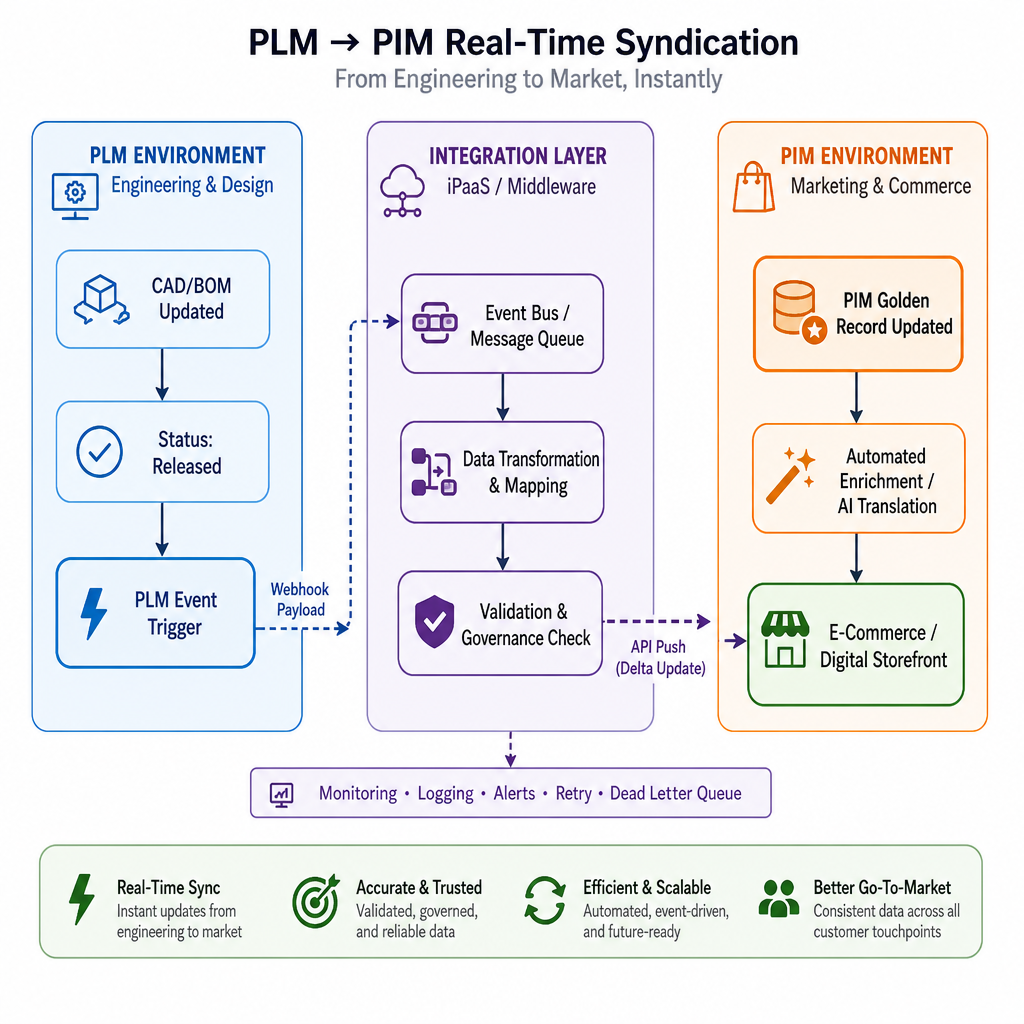
(The following flowchart illustrates the real-time data syndication process.)
Code snippet
graph TD
    subgraph PLM Environment [Engineering & Design]
        A[CAD/BOM Updated] --> B(Status: Released)
        B --> C{PLM Event Trigger}
    end

    subgraph Integration Layer [iPaaS / Middleware]
        C -- Webhook Payload --> D[Event Bus / Message Queue]
        D --> E[Data Transformation & Mapping]
        E --> F[Validation & Governance Check]
    end

    subgraph PIM Environment [Marketing & Commerce]
        F -- API Push (Delta Update) --> G[PIM Golden Record Updated]
        G --> H[Automated Enrichment / AI Translation]
        H --> I((E-Commerce / Digital Storefront))
    end

    style A fill:#e1f5fe,stroke:#0288d1
    style G fill:#fff3e0,stroke:#f57c00
    style I fill:#e8f5e9,stroke:#388e3c
4. Bridging the Data Models: From Engineering to Commerce
The hardest part of real-time syndication is not the networking—it is the semantic translation. A PLM system structures data hierarchically (e.g., assemblies, sub-assemblies, individual parts). A PIM system often structures data by product family, variant, and SKU.
Data Mapping Strategies
- Engineering BOM (eBOM) to Commercial BOM: PLM holds the eBOM (how the product is built). Integration layers must extract only the relevant attributes (weight, material composition, power requirements) to form a Commercial BOM or commercial attribute set.
- Dimensional Translation: An engineer might model a part in millimeters with a tolerance of +/- 0.05. The PIM needs this translated to generalized commercial dimensions (e.g., “15 inches”) for the end consumer.
- Digital Asset Transformation: PLM systems store heavy 3D CAD files (STEP, IGES). Real-time syndication pipelines can automatically trigger rendering engines to convert these heavy engineering files into lightweight WebGL, USDZ, or glTF formats for PIM to use in 3D product configurators on e-commerce sites.
5. The Role of Artificial Intelligence in Syndication
In 2026, integration is no longer just about moving data; it’s about understanding data. AI and Large Language Models (LLMs) are being embedded directly into the iPaaS and PIM layers to facilitate smooth handoffs.
- Automated Text Generation: When the PLM sends a raw list of materials and technical specs to the PIM, an AI agent can instantly draft SEO-optimized, customer-facing product descriptions based on those raw attributes.
- Semantic Mapping: Machine learning algorithms can automatically detect schema mismatches between an older PLM instance and a modern PIM, suggesting mapping routes for new attributes without requiring a developer to write integration code.
- Data Governance: AI acts as a real-time gatekeeper. If a PLM update pushes a product weight that deviates by 500% from similar products (suggesting an engineering typo), the AI halts the syndication to the storefront and flags it for human review.
Table 2: The ROI of PLM-PIM Integration
| Metric | Pre-Integration Baseline | Post-Integration Result | Impact |
| New Product Setup Time | 14 – 21 Days | 1 – 2 Days | 90% faster time-to-market |
| Data Accuracy on Site | ~82% | 99.9% | Significant drop in return rates |
| Manual Data Entry Hours | 40 hours / week | 2 hours / week | Redirected to strategic marketing |
| Omnichannel Rollout | Sequential (one channel at a time) | Simultaneous across all channels | Immediate global revenue realization |
6. Overcoming Integration Challenges
While the benefits are immense, bridging this gap requires overcoming several hurdles:
- The Culture Clash: Engineering teams prioritize precision and configuration control; marketing teams prioritize speed, narrative, and consumer appeal. Cross-functional governance boards must be established so both teams agree on which system “owns” which data fields (e.g., PLM owns “Material”, PIM owns “Marketing Description”).
- Legacy System Bottlenecks: Older on-premise PLMs may lack robust REST APIs. In these cases, middleware must rely on database polling or custom-built connectors, which can simulate real-time updates but introduce technical debt.
- Version Control vs. Live Data: PLMs rely heavily on rigid revision control (Rev A, Rev B). E-commerce needs a continuous stream of the “currently active” product. The integration layer must be smart enough to only syndicate released, active revisions rather than work-in-progress (WIP) data.
7. Looking Ahead: The Closed-Loop Future
As we progress through 2026, the syndication between PIM and PLM is evolving from a one-way street (PLM -> PIM) into a closed-loop system. E-commerce platforms fed by PIM are gathering massive amounts of consumer behavior data.
In the near future, if a specific configuration of a product is highly successful on the digital storefront, or if consumers are constantly returning a product due to a specific misunderstood specification, the PIM will feed this market sentiment and configuration data back into the PLM. This will inform the next generation of product ideation, allowing engineers to design with real-world commercial performance data at their fingertips.
Conclusion
The divide between engineering and marketing is no longer sustainable. Real-time syndication between PLM and PIM is the digital thread that connects the brilliant minds designing your products with the eager customers ready to buy them. By leveraging event-driven architectures, modern middleware, and AI-driven enrichment, organizations can eliminate costly delays, ensure absolute data fidelity, and conquer the omnichannel marketplace.