The manufacturing world has spent the last few years experimenting with generative AI copilots. We’ve all seen them: the handy chat windows embedded in software that help engineers retrieve parts data, summarize compliance documents, or parse massive PDF manuals. In my previous article we talked about the shift from PLM to Product Lifecycle Intelligence
But while copilots are great at fetching information when prompted, they still rely entirely on human direction to get things done. They are passive.
Enter Agentic AI.
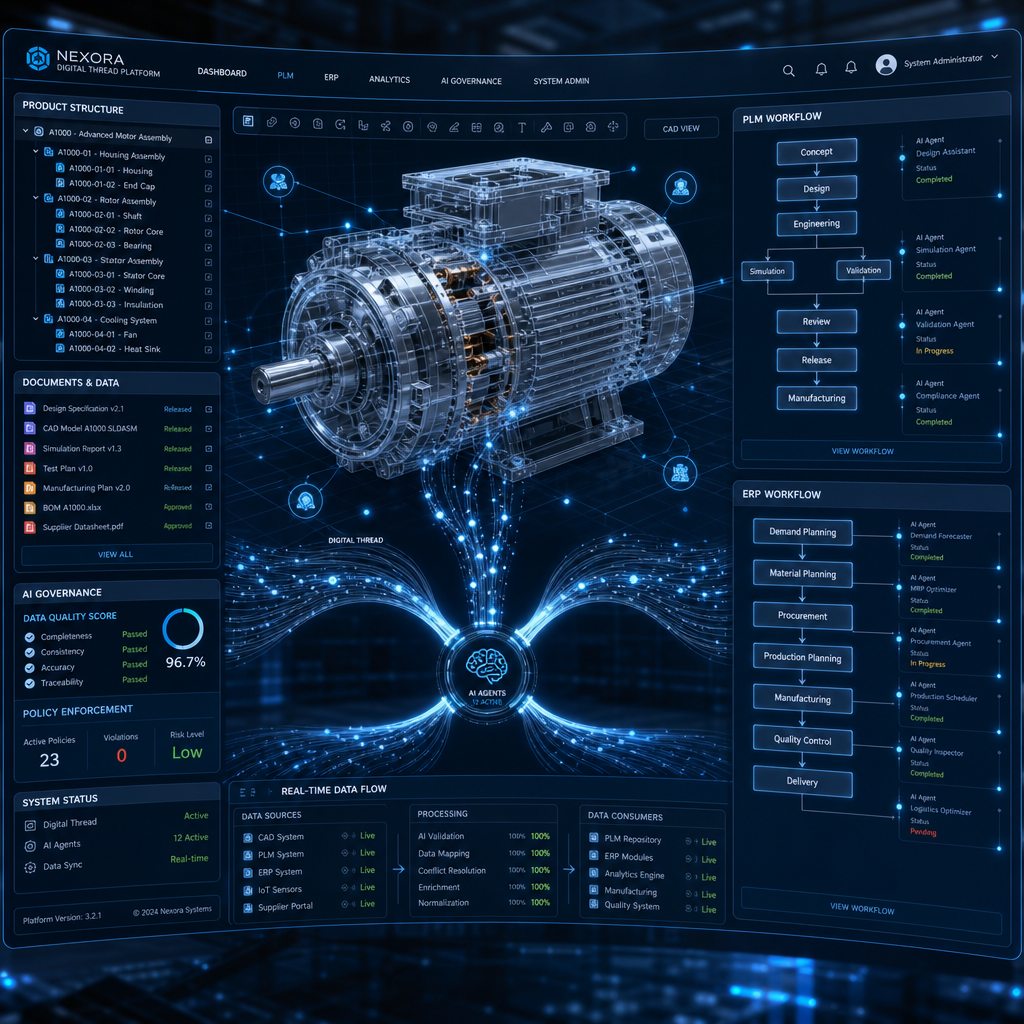
We are currently shifting away from traditional, isolated data management toward interconnected, intelligent enterprise ecosystems. In this new landscape, AI is moving from a helpful assistant to an autonomous collaborator. In Product Lifecycle Management (PLM), agentic workflows aren’t just rewriting the rules—they are fundamentally altering how products are engineered, governed, and updated.
What is Agentic AI in PLM?
Unlike a standard AI copilot that waits for a specific prompt (e.g., “Find the latest revision of Part X”), Agentic AI operates on intent and objectives. It uses autonomous AI agents capable of planning, making decisions, using tools, and executing complex workflows with minimal human intervention.
In a PLM ecosystem, an agent doesn’t just tell you there is a problem; it coordinates across your CAD, PLM, and ERP systems to fix it. It handles the manual, bureaucratic overhead that typically bogs down engineering teams.
Automated Engineering Change Orders (ECOs)
Ask any engineering manager about their biggest operational bottleneck, and they will likely point to the Engineering Change Order (ECO) process. Managing an ECO historically requires tracking down legacy data chaos, assessing downstream impacts, and manually routing approvals.
Agentic AI changes the game by handling Engineering Change Order automation:
- Impact Analysis: When a part change is proposed, an AI agent autonomously scans the entire multi-domain Bill of Materials (BOM) to find every assembly, supplier, and manufacturing line affected by the alteration.
- Workflow Execution: Instead of waiting for a human to route documentation, the agent drafts the ECO, attaches the necessary CAD visualizations, and forwards it to the exact stakeholders needed for approval based on historical corporate data.
Proactive Compliance and Data Governance
Maintaining clean data and compliance across a product’s lifecycle is a constant uphill battle. Instead of waiting for a regulatory audit to find a mistake, agentic workflows introduce automated data governance directly into the digital thread.
AI agents can run in the background of your PLM system to autonomously flag compliance risks before they become costly liabilities. For example, if a designer selects a material that violates updated environmental regulations (like RoHS or REACH), an autonomous agent can instantly flag the risk, pause the lifecycle state, and suggest compliant alternatives from the approved manufacturer list.
Cleaning Up Legacy CAD Chaos
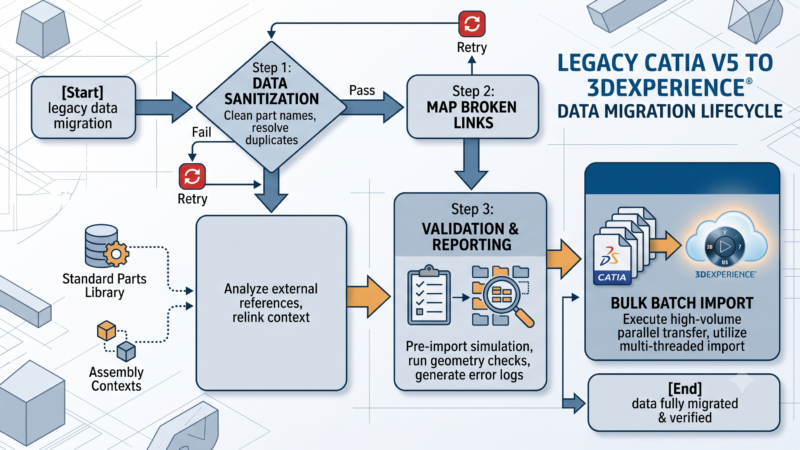
Decades of engineering data often leave enterprises with a messy digital graveyard—duplicate parts, broken links, missing metadata, and conflicting revisions. Manually cleaning this data is a nightmare project that engineers dread.
Agentic AI can be deployed to systematically decode legacy CAD chaos. By understanding geometric shapes, metadata, and historical context, these agents can:
- Identify and merge duplicate part numbers.
- Standardize naming conventions across millions of files.
- Automatically enrich old data models with correct tags, making legacy data instantly searchable and usable for modern generative design tools.
The New Reality: Humans in the Loop
Does this mean AI is replacing engineers? Absolutely not.
The true power of Agentic AI lies in shifting the engineer’s role from data administrator to ultimate decision-maker. Instead of spending 60% of their day manually clicking through PLM workflows, filling out compliance forms, and fixing data errors, engineers can focus entirely on innovation. The AI agent handles the heavy operational lifting, presenting the human expert with optimized choices and clear data for final approval.
The era of the passive copilot is winding down. The future of PLM belongs to autonomous, agentic workflows that keep the digital thread moving at the speed of thought.