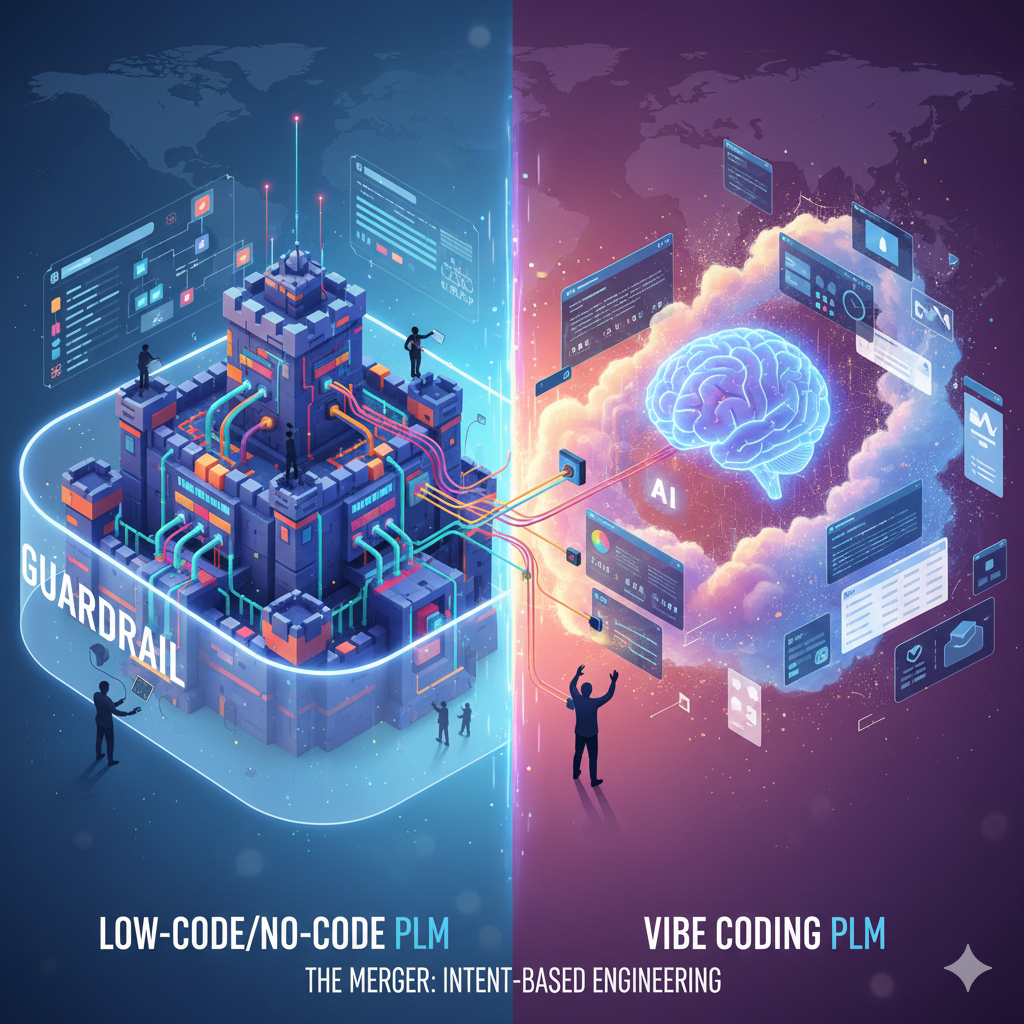
For the last five years, the mantra in Product Lifecycle Management (PLM) has been “democratization.” We were told that Low-Code/No-Code (LCNC) platforms would finally break the bottleneck of expensive PLM consultants and rigid proprietary code. The promise was simple: give engineers a drag-and-drop interface, and they will build the workflows they need without bothering IT.
But as we settle into 2026, a new challenger has entered the arena, and it doesn’t use a mouse or a visual canvas. It’s called “Vibe Coding.”
The term, popularized by pioneers like Andrej Karpathy, describes a shift toward “Agentic Software Creation.” Instead of dragging boxes on a screen, users describe their intent, their “vibe,” and their desired outcome to an AI agent that generates the underlying production-grade code instantly.
This raises an existential question for the industry: If an AI can write a custom PLM integration or a specialized Bill of Materials (BOM) dashboard from a single paragraph of text, is there any reason left to use a low-code platform?
What exactly is Vibe Coding?
In a PLM context, “vibe coding” isn’t just about simple automation; it’s about intent-based engineering.
Imagine an engineer who needs a custom tool to pull environmental compliance data from a Tier 2 supplier’s API and map it against a specific assembly in the PLM.
- The Traditional Way: Write a Jira ticket, wait six months for a developer, and pay for 100 hours of custom Java code.
- The Low-Code Way: Use a visual orchestrator like Mendix or OutSystems. Spend three days mapping data connectors and dragging logic gates into a proprietary workflow.
- The Vibe Coding Way: Open an AI-native editor (like Cursor, Lovable, or a PLM-specific agent). Type: “Build a React dashboard that connects to our Teamcenter instance and the GreenSoft API. Highlight any part in Assembly X-100 that lacks a RoHS certificate. Make the UI look like our internal design system.”
Within seconds, the AI doesn’t just suggest code; it builds the environment, configures the API calls, and presents a working application. The engineer is no longer a “builder” in the traditional sense; they are a conductor.
The “Great Compression” of Low-Code
Low-code platforms exist to provide an abstraction layer. They hide the “scary” code behind a friendly interface. However, Vibe Coding effectively removes the need for the abstraction layer itself.
When AI can handle the “scary” code directly, the visual blocks of a low-code platform start to feel like training wheels on a motorcycle—they actually slow you down. This is leading to what industry analysts call the “Great Compression.” Standard PLM tasks—dashboards, simple approval workflows, and data connectors—are becoming commodities.
If you can vibe-code a custom supplier portal in an afternoon, the value proposition of a $100k-a-year low-code platform subscription begins to crumble.
Why PLM Isn’t Quite Ready to Give Up Control
If vibe coding is so much faster, why hasn’t every PLM manager fired their low-code developers? Because PLM isn’t just “software”—it is the legal and technical record of a physical product. In industries like aerospace, medical devices, and automotive, “vibes” aren’t enough.
1. The Governance Gap
Vibe coding generates “raw” code (Python, JavaScript, SQL). While powerful, this code often lacks the built-in governance that enterprise LCNC platforms provide. Who owns this code? Is it being version-controlled? Did the AI accidentally include a security vulnerability or a hard-coded API key?
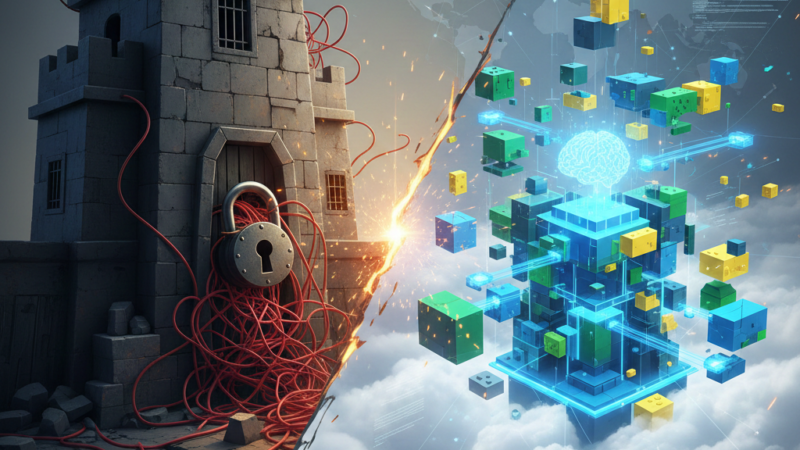
LCNC platforms like Siemens Mendix or PTC ThingWorx provide a “walled garden.” They ensure that whatever a citizen developer builds is inherently compliant with the company’s security protocols. Vibe coding, in its current state, is a “Wild West” that requires a high level of human oversight to be production-ready.
2. The Maintenance “Zombie” Problem
One of the biggest risks of vibe coding in PLM is the creation of “Zombie Apps.” These are highly functional tools created by an engineer who “vibed” them into existence but doesn’t actually understand the code the AI generated.
Three years later, when that engineer leaves the company and the API changes, the tool breaks. Because no one actually wrote the code, no one knows how to fix it. LCNC platforms, with their visual logic, are much easier for a successor to “read” and maintain.
3. Data Lineage and the “Single Source of Truth”
PLM is built on complex relationships. If an AI agent generates a tool that modifies a BOM but doesn’t follow the strict referential integrity rules of the parent PLM system, it can corrupt the database. Low-code tools built inside the PLM ecosystem are “aware” of these rules by default. Vibe coding tools are only as aware as the prompt allows them to be.
The 2026 Shift: The Rise of “Vibe-Enabled” Platforms
We aren’t seeing the death of low-code; we are seeing its evolution. The most successful PLM vendors in 2026 aren’t fighting vibe coding; they are absorbing it.
We are entering the era of Hybrid Development. The future of PLM customization looks like this:
- The Foundation: A secure, cloud-native PLM platform with a robust API layer.
- The Guardrails: A low-code governance layer that manages identity, security, and data integrity.
- The Interface: A “vibe coding” front-end where the user describes their needs in natural language, and the platform uses its internal AI to assemble the components within the secure low-code environment.
In this model, the “vibe” provides the speed, while the “platform” provides the safety.
How PLM Leaders Should Prepare
If you are an IT leader or a PLM architect, the rise of vibe coding should change your strategy for the next three years.
- Stop Investing in “Closed” Low-Code: If a platform doesn’t allow you to export your code or interact via open APIs, it will become a legacy anchor. Vibe coding thrives on openness.
- Focus on “Prompt Engineering” for Engineers: Your mechanical and electrical engineers don’t need to learn Java, but they do need to learn how to define technical requirements for AI agents. This is the new “literacy” of the engineering world.
- Build a “Digital Sandbox”: Create a secure environment where engineers can experiment with vibe coding tools (like Cursor or GitHub Copilot) without touching the production PLM database. Let them prototype at the speed of thought, then have a professional developer “harden” the code before it goes live.
Final Thoughts: The Verdict
Is vibe coding the end of low-code/no-code in PLM? No—it is the end of low-code as we knew it.
The era of spending months dragging boxes to build a simple workflow is over. Vibe coding has set a new bar for speed and creativity. However, the complexity of engineering data means we still need the structure, security, and longevity that platforms provide.
The winners of the next decade won’t be the “Vibe Coders” or the “Low-Coders.” They will be the “System Orchestrators”—those who can use AI to manifest their intent while utilizing robust, cloud-native architectures to ensure those manifestations don’t crumble under the weight of reality.
The vibe is fast, but the record is forever. In PLM, you need both.