As organizations accelerate their adoption of artificial intelligence, many teams are questioning whether traditional Agile practices are still relevant. Terms like AI Sprint, ML Sprint, and Data Sprint are becoming common in enterprise roadmaps, leading to a misconception that traditional sprints are outdated.
They are not.
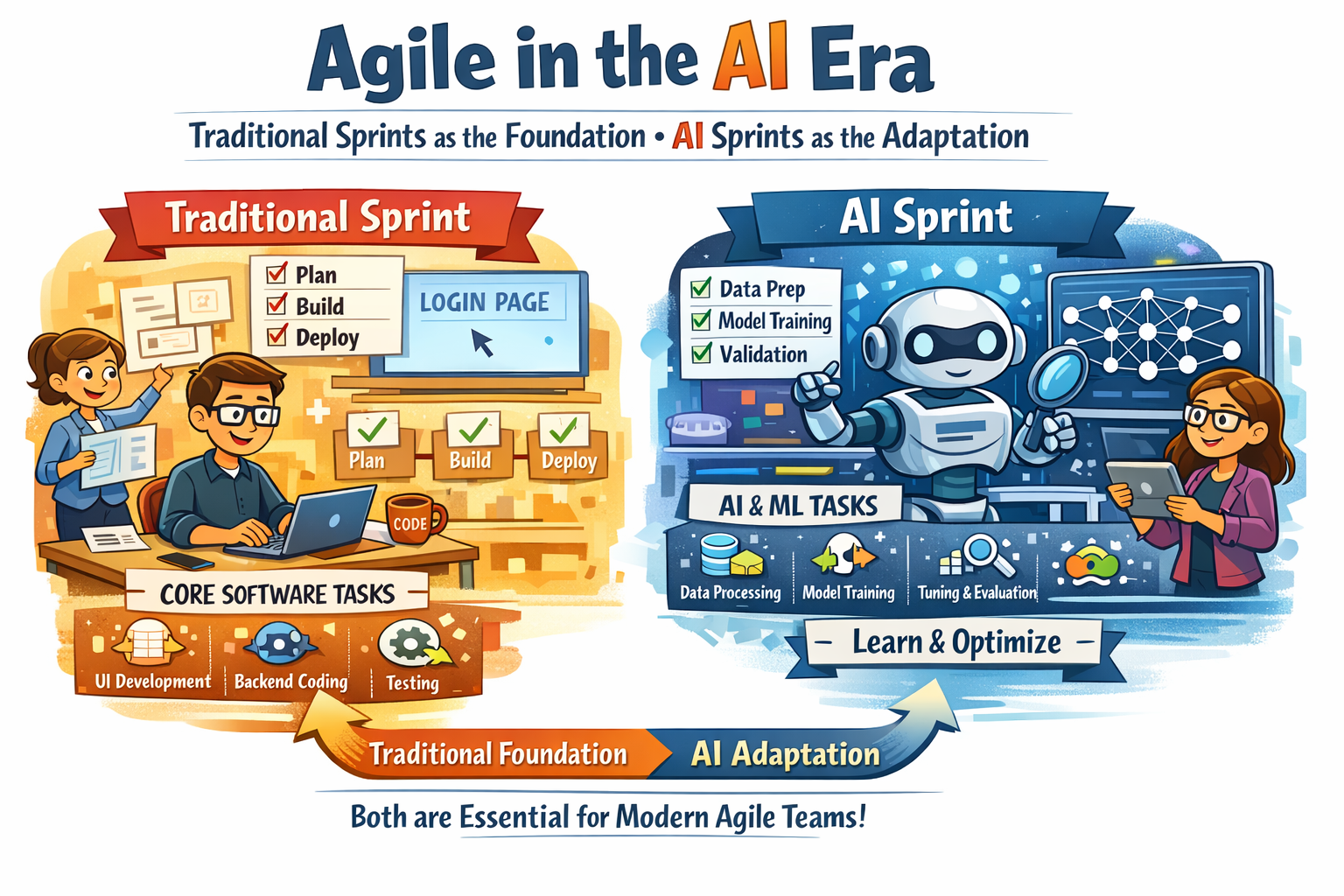
Traditional Agile sprints remain the core execution engine of modern software delivery. What has changed is how teams adapt sprint execution when AI/ML capabilities are introduced.
Traditional Sprints: The Engineering Backbone
Traditional sprints are optimized for deterministic engineering work:
- Clearly defined requirements
- Predictable outcomes
- Rule-based system behavior
- Feature-driven delivery
Examples include:
- Authentication and authorization systems
- UI/UX development
- APIs and backend services
- Dashboards and reporting layers
In these scenarios, Agile works exactly as intended: plan, build, test, deploy.
Traditional sprints are not replaced in AI programs—they are embedded within them.
Why AI Introduces a Different Sprint Dynamic
AI-enabled features introduce non-determinism into the system:
- Models learn from data, not fixed rules
- Outcomes cannot be guaranteed upfront
- Performance depends on data quality, volume, and bias
- Continuous retraining is required
This forces Agile teams to shift sprint goals from feature completion to validated learning.
That shift is what we refer to as an AI Sprint.
AI Sprint: An Adaptation, Not a New Methodology
An AI Sprint does not replace Agile ceremonies or principles.
It adapts them to support:
- Data preprocessing and feature engineering
- Model training, evaluation, and tuning
- Bias, fairness, and explainability checks
- Continuous feedback and retraining loops
In practice, an AI Sprint often includes traditional sprint work plus AI-specific workflows.
Example:
- Traditional Sprint: Build a login page
- AI Sprint: Build the login page and integrate a risk-scoring model that predicts suspicious login attempts
The sprint still delivers software—but also delivers insights, metrics, and learning.
When to Use Traditional vs AI Sprints
| Scenario | Sprint Type | Reason |
|---|---|---|
| Static login page | Traditional | Deterministic logic, known outcome |
| Recommendation engine | AI | Data-driven learning required |
| Notification service | Traditional | Rule-based behavior |
| Fraud detection system | AI | Predictive modeling and continuous adaptation |
| CRUD application | Traditional | Fixed requirements |
Rule of thumb:
If the system behavior depends on learning from data → AI Sprint
If the system behavior is rule-based → Traditional Sprint
Enterprise Impact: Velocity, Story Points, and Planning
AI Sprints typically:
- Increase story point estimates due to experimentation
- Add tasks such as data validation and model evaluation
- Reduce predictability but increase long-term value
This does not mean teams are slower—it means progress is measured in risk reduction and knowledge acquisition, not just completed tickets.
Mature organizations account for this by:
- Separating AI stories from traditional stories
- Measuring success via model metrics and business impact
- Accepting that failed experiments still deliver value
The Bottom Line
Traditional Agile sprints are not obsolete in the AI era.
They remain the structural foundation of product delivery.
AI Sprints are an adaptation—a specialized way of running sprints when products include AI/ML capabilities, uncertainty, and continuous learning.
The most successful organizations don’t choose between Traditional or AI Sprints.
They use both intentionally, based on the nature of the work.
That balance is what defines modern, high-performance Agile teams.