Working with contract manufacturers (CMs) is a cornerstone of modern product development. They bring specialized expertise, scale, and often, cost efficiencies that are simply unattainable in-house. But there’s a delicate dance involved – one where collaboration is key, but the security and integrity of your intellectual property (IP) are paramount.
The challenge? How do you share the exact, up-to-date product data a CM needs to build your vision, without exposing your crown jewels to unnecessary risk? It’s a trust bridge you have to build carefully, piece by digital piece.
For too long, this process has been a patchwork of emailed files, FTP sites, and shared cloud drives – a recipe for version control chaos, security vulnerabilities, and ultimately, costly mistakes. In today’s interconnected world, that approach simply doesn’t cut it. We need collaborative environments that are both robust and secure.
The Perils of “Traditional” Sharing Methods
Let’s be honest, we’ve all been there. You’ve got a critical deadline, and you need to get the latest CAD models, BOMs, and manufacturing instructions to your CM ASAP. So, what happens?
- Emailing Attachments: The classic culprit. It’s fast, but immediately creates multiple, unmanaged copies. Which one is “final”? Who saw which version? Good luck tracking that. It’s a security sieve, too.
- FTP Sites/Generic Cloud Drives: A slight step up, offering centralized storage. But often lacking granular access controls, audit trails, and the ability to link data to specific product structures. “Anyone with the link” can quickly become “everyone with the link.”
- Physical Hand-offs: Still surprisingly common for highly sensitive data, but incredibly slow, impractical for revisions, and leaves no digital trail.
- Manual Data Extraction & Redaction: Someone spends hours removing proprietary design elements, internal notes, or supplier pricing before sending the “CM version.” This is slow, error-prone, and often incomplete.
Each of these methods introduces risk – from intellectual property theft and unauthorized modification to simply building the wrong revision of a product because the CM wasn’t looking at the most current data.
Building the Trust Bridge: The Role of Collaborative PLM
The answer lies in leveraging your Product Lifecycle Management (PLM) system as the central hub for external collaboration. This isn’t just about managing your internal data; it’s about extending that controlled environment to your trusted partners.
Here’s how a modern, collaborative PLM architecture helps you safely share product data with CMs:
1. Granular Access Control: Share Exactly What’s Needed, Nothing More
This is the absolute foundation. A robust PLM allows you to define user roles and permissions with extreme precision. Instead of giving a CM access to an entire project folder, you can grant them access only to:
- Specific parts of a Bill of Materials (BOM).
- Approved CAD models (perhaps even derivative formats like STEP files, not native CAD).
- Released manufacturing instructions and quality documents.
- Specific revisions of each document.
This “need-to-know” principle is your first line of defense. If they don’t need to see your internal cost structures or unreleased design iterations, they shouldn’t have access.
2. Secure, Cloud-Based Portals: Your Private Digital Handshake
Forget generic cloud drives. Modern PLM systems offer secure, web-based portals specifically designed for supplier collaboration. These are not just file repositories; they are interactive environments where CMs can:
- View the latest released data.
- Acknowledge receipt of new revisions.
- Submit questions or proposed changes directly linked to the specific document or part.
- Access a controlled workspace, ensuring their environment is clean and up-to-date.
This means you control the environment, the data, and the interaction.
3. Automatic Version and Revision Control: One Source of Truth, Always
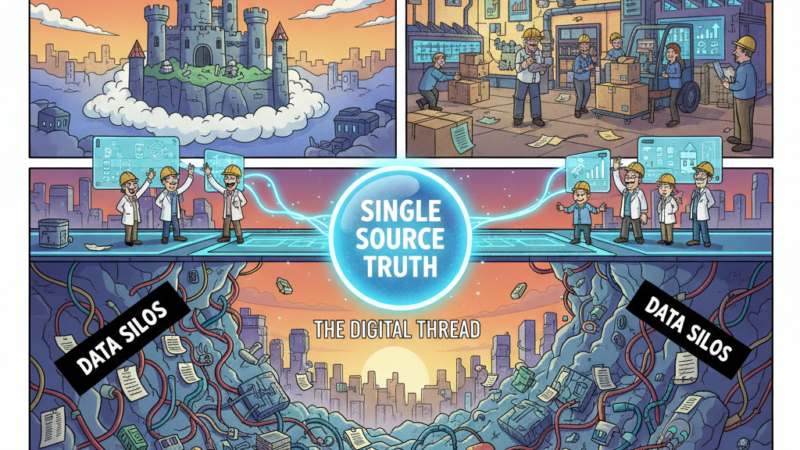
This is perhaps the most significant benefit. When your CM is accessing data directly from your PLM, they are always seeing the latest, released version. There’s no ambiguity, no “which email did you send?” confusion. Every time you release an Engineering Change Order (ECO) that affects the CM’s scope, the updated documentation is immediately available, and often, an automatic notification is sent. This drastically reduces the risk of building to an outdated spec.
4. Audit Trails: The Digital Fingerprint
Who accessed what, when, and from where? A proper PLM system provides a complete audit trail. This is invaluable for:
Accountability: If a mistake happens, you can trace exactly which data was being viewed by the CM at that time.
Compliance: Essential for regulated industries that require full traceability of design and manufacturing data.
Security: Detects unauthorized access or suspicious activity.
5. Redaction and Derivation Tools: Smart Sharing
Some PLM systems offer advanced capabilities to automatically redact sensitive information or generate “derivative” files. For example, you might share a view-only 3D model that allows a CM to analyze fit and clearances but doesn’t expose proprietary internal geometry or material compositions. This allows you to share contextual information without giving away core IP.
6. Structured Feedback and Collaboration Workflows
Instead of phone calls and emails, CMs can submit formal requests for information (RFIs) or proposed design changes directly within the PLM portal, linked to the relevant part or document. This makes communication clear, traceable, and integrated into your overall change management process.
More Than Just Software: Building the Relationship
While the technology is crucial, successful collaboration with CMs also hinges on the human element:
Clear Contracts & NDAs: Technology supports legal agreements; it doesn’t replace them.
Defined Processes: Clearly outline how data will be shared, how feedback will be given, and what constitutes a “released” document.
Trust and Communication: Regular check-ins and an open dialogue are essential for any successful partnership. The PLM system is a tool to facilitate this, not replace it.
Training: Ensure your CMs are properly trained on how to use your collaboration portal. A powerful tool is only useful if it’s adopted.
Conclusion: Your Product’s Digital Passport
Sharing product data with contract manufacturers is no longer a risk to be tolerated; it’s an opportunity to optimize your entire value chain. By moving away from fragmented, ad-hoc methods and embracing the power of a collaborative PLM environment, you’re not just enhancing security – you’re building a more efficient, transparent, and ultimately, more innovative relationship with your most critical partners.
Think of your PLM as providing your product data with a secure, trackable digital passport. It ensures that your valuable IP travels safely, arrives intact, and can be verified at every checkpoint, empowering your CMs to build your products with precision and confidence.