For the last couple of years, we’ve all been living in the “Age of the Prompt.” We learned how to sweet-talk LLMs, crafting the perfect paragraph to get a semi-decent blog post or a snippet of code. It felt like magic, but let’s be honest—it was also a bit of a chore. You’d prompt, wait, tweak, prompt again, and then manually copy-paste the result into wherever it actually needed to go.
As we move through 2026, that “chatbot” era is officially hitting its sunset.
The new sunrise? Agile AI and Agentic Workflows. We are moving away from AI as a digital vending machine (where you put in a coin and get a snack) and toward AI as a colleague—systems that don’t just talk, but do. They plan, they reason, they use tools, and they fix their own mistakes. If 2023 was the year of the Chatbot, 2026 is the year of the Agent.
What Exactly is an “Agentic Workflow”?
To understand why this is a big deal, we have to look at how we used to use AI. Usually, it was a “Zero-Shot” interaction: you give a prompt, and the AI gives one long, continuous response. If the response was wrong, you were the one who had to fix it.
An Agentic Workflow flips the script. Instead of one giant leap from prompt to answer, the AI takes a series of small, iterative steps. It looks something like this:
- Analyze: The AI looks at the goal (e.g., “Research this company and write a partnership proposal”).
- Plan: It breaks the goal into sub-tasks.
- Execute: It uses tools—searching the web, reading PDFs, checking LinkedIn.
- Reflect: It looks at its own draft and says, “Wait, I missed their latest quarterly earnings report.”
- Iterate: It goes back, gets the data, and fixes the draft before you ever see it.
This is Agile AI. It’s the application of agile principles—iteration, flexibility, and constant feedback—to the way the AI itself functions.
The Shift: From “Instruction” to “Intention”
In a traditional workflow, the human is the project manager, the editor, and the glue. You are the one coordinating between your email, your CRM, and your AI tool.
With agentic workflows, we are moving toward Intention-Based Computing. You provide the “intent” (the what and the why), and the AI handles the “how.”
The “Coworker” vs. The “Calculator”
Think of traditional AI like a high-powered calculator. It’s brilliant, but it only works when you press the buttons. An Agentic AI is more like a junior partner. You can tell it, “I need to get our onboarding process updated by Friday,” and it will go find the current documents, identify the gaps, draft the updates, and Slack you a link to the folder for review.
Why “Agile” is the Secret Sauce
The reason we’re calling this “Agile AI” is that these systems thrive on the same loop that software teams have used for decades: Plan → Act → Observe → Adapt.
- Self-Correction: One of the most human-like traits of agentic workflows is the ability to say, “I got this wrong.” In an agile loop, the agent can run a piece of code, see an error message, and rewrite the code until it works.
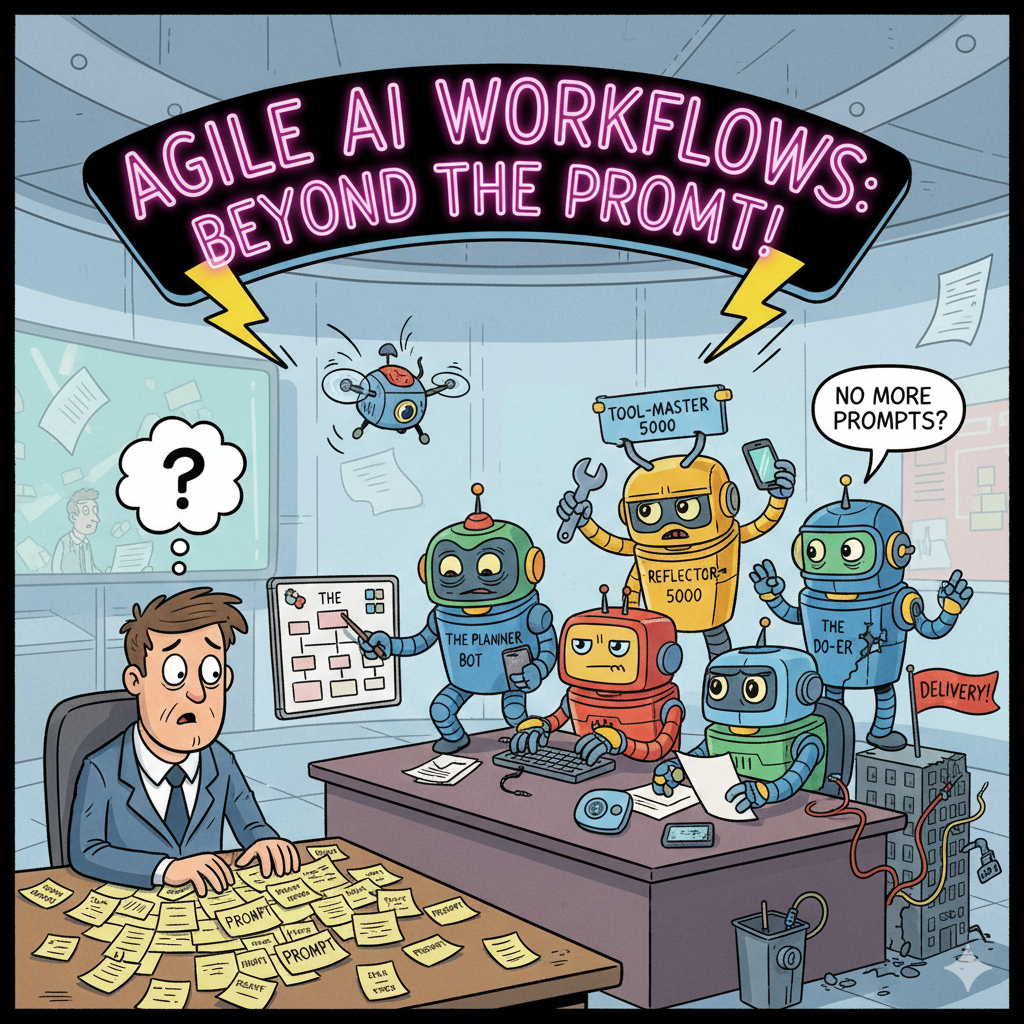
- Multi-Agent Orchestration: We’re seeing the rise of “squads.” You might have one agent focused on research, one on creative writing, and one on “criticism” (fact-checking). They pass work back and forth in a digital scrum, ensuring the final output is far higher quality than what a single prompt could ever produce.
- Dynamic Tool Use: Agile AI isn’t locked in a box. It can “reach out” and use the tools you use—browsers, terminal windows, API connectors—making it a part of your actual work environment rather than a separate tab on your screen.
How This Changes the Way We Work (and Live)
This isn’t just a technical upgrade; it’s a cultural shift. If the AI is handling the “doing,” what are the humans doing?
1. The Death of the “First Draft”
In 2026, no one starts with a blank page. Whether you’re writing a legal brief, a marketing plan, or a software architecture, the “Agentic Squad” has already prepared a high-fidelity first draft based on your specific data and style. Your job is no longer to create, but to curate and direct.
2. From Coder to Architect
For software developers, Agile AI is a godsend. We’ve moved past simple code completion. Agents can now handle entire “tickets.” They can find a bug, write the test case to reproduce it, fix the bug, and submit a pull request. Developers are becoming “System Architects,” overseeing the logic and the “spirit” of the code while the agents handle the syntax.
3. Real-Time Business Intelligence
Imagine a supply chain agent that doesn’t just show you a dashboard of a delay in the Suez Canal, but actually acts on it—re-routing shipments, notifying customers, and updating the inventory system—and then presents you with the summary of what it did and why. That is the power of an autonomous workflow.
The Challenges: Governance and Trust
Of course, giving AI the “keys to the car” comes with risks. We can’t just let agents run wild. This is where Human-in-the-Loop (HITL) governance becomes critical.
In 2026, the best organizations aren’t the ones with the fastest AI; they are the ones with the best guardrails. * Approval Gates: At what point must an agent stop and ask for a human “thumbs up”? (Usually for anything involving spending money or external communication).
- Traceability: Can the AI explain why it made a specific decision? If an agent re-routed a shipment, we need to see the “thought trace” that led to that action.
- Agentic Drift: Just like humans, AI systems can get “distracted” or start hallucinating over long multi-step tasks. Continuous monitoring is the “Agile” way to keep them on track.
The Future: A Blended Workforce
As we look toward the rest of 2026 and beyond, the line between “human work” and “AI work” will continue to blur. We are entering an era of Connected Intelligence. We won’t talk about “using AI” anymore. It will just be how work happens. You’ll have a “digital twin” or a suite of agents that know your preferences, your files, and your goals. They will be the silent engine running in the background, handling the logistics of your life so you can focus on what humans do best: building relationships, solving complex ethical dilemmas, and dreaming up what comes next.
The rise of Agile AI isn’t about replacing us—it’s about unburdening us. It’s about taking the “robot” out of the human, so we can finally get back to being creative, strategic, and remarkably human.
Final Thoughts: Are You Ready?
The shift to agentic workflows is happening fast. If you’re still thinking in terms of “how do I write a better prompt,” you’re playing the 2023 version of the game. The 2026 version is: “How do I build a system that can work for me?”
It’s time to stop talking to our computers and start delegating to them. The age of the agent is here.