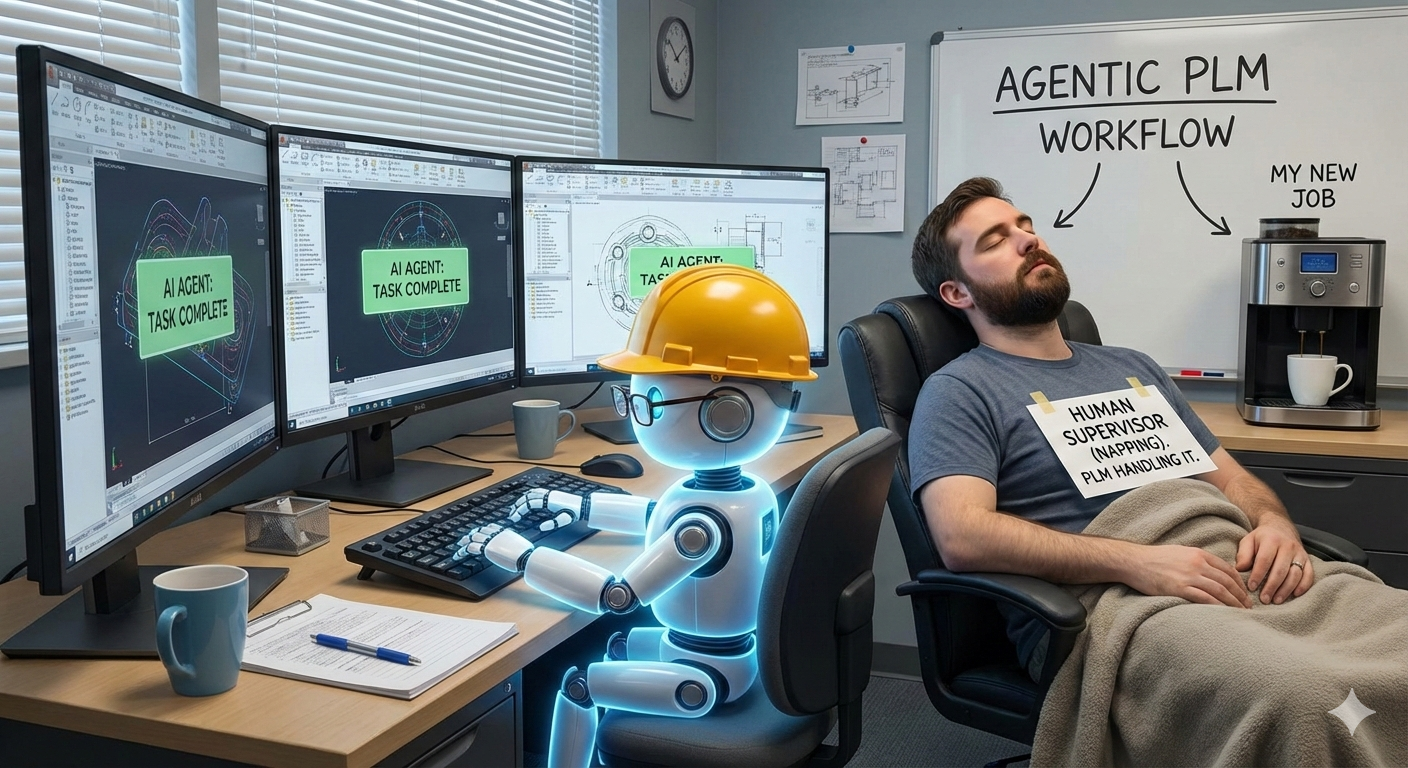
By late 2025, the initial hype cycle surrounding generative AI in engineering had begun to settle into practical reality. We spent a couple of years being impressed that an LLM could summarize a fifty-page requirements document or generate a basic Python script for data extraction. Many PLM vendors slapped a “Copilot” sticker on their interface and called it a revolution. But for the average engineer knee-deep in complex assembly structures and regulatory compliance compliance protocols, these tools often felt like glorified search engines. They could retrieve information, but they couldn’t actually do anything with it.
Dawn of Agentic PLM
This limitation is driving the most significant shift in Product Lifecycle Management we have seen in a decade: the transition from passive data repositories to active, autonomous systems. This is the dawn of “Agentic PLM,” a paradigm where AI isn’t just waiting to answer your questions—it is actively working in the background to anticipate problems and execute tasks.
The fundamental difference between the AI chatbots of 2024 and the autonomous agents of today lies in the concept of “agency.” A traditional chatbot is reactive; it requires a prompt from a human to function. It is a tool waiting to be picked up. An AI agent, integrated deeply into the PLM architecture, is proactive. It is given a goal—such as “maintain BOM integrity” or “monitor supplier sustainability compliance”—and it autonomously takes steps to achieve that goal within defined guardrails. It moves PLM from being a mere System of Record to a genuine System of Action.
Imagine a scenario common to any complex manufacturing environment: a critical component goes end-of-life (EOL) unexpectedly at a sub-tier supplier. In the traditional PLM world, this information might sit in an email inbox for days before a human engineer realizes the implication. Then begins the arduous process of manual impact analysis, searching through “where-used” queries to find every affected assembly.
In an Agentic PLM environment, this workflow changes dramatically. An autonomous agent dedicated to supply chain resilience constantly scans supplier databases. Upon detecting the EOL notice, the agent immediately triggers an internal workflow. It doesn’t just send an alert; it performs the impact analysis automatically, identifying every affected BOM across product lines. It then queries internal databases for approved alternatives with similar specifications and drafts an Engineering Change Order (ECO) populated with the proposed replacement part and the necessary stakeholder approvals. By the time the lead engineer opens their dashboard in the morning, the problem has been identified, analyzed, and a solution is waiting for their final stamp of approval.
The trust factor
This shift toward autonomous engineering requires us to rethink the architecture of trust within engineering organizations. For decades, engineering rigor has relied on human eyes verifying every detail. Moving to an agentic model doesn’t mean abandoning that rigor; it means codifying it. We are moving from “human-in-the-loop” for every minor transaction to a “human-on-the-loop” supervisory model.
Engineers must define the strict parameters and confidence intervals within which these agents operate. For example, an agent might be fully authorized to automatically swap out a standard fastener if the original is out of stock, provided the shear strength and material properties are identical. However, if that same agent detects a potential conflict in a safety-critical subsystem, its programming dictates that it must immediately escalate the issue to a human specialist rather than attempting an autonomous fix. The engineering challenge shifts from managing data to managing the rules that govern the data’s behavior.
The implications for the engineering workforce are profound, and contrary to popular fears, it does not mean the end of the human engineer. Instead, it signifies the end of the engineer as a high-paid data entry clerk. So much of modern engineering has become administrative burden—chasing down missing metadata, formatting reports, and double-checking compliance checkboxes. Agentic PLM aims to automate this administrative drudgery.
When the system is handling the synchronization between the ECAD and MCAD BOMs autonomously, the mechanical and electrical engineers get that time back. They can reinvest that energy into genuine innovation, complex problem-solving, and optimizing product architecture—the creative work that drew them to engineering in the first place. We are evolving from operating the machinery of PLM to orchestrating a symphony of intelligent agents that keep the machinery running.
As we look deeper into 2026 and beyond, Agentic PLM will become the standard operating procedure for competitive manufacturing enterprises. The volume and velocity of product data have simply outpaced human capacity to manage it manually without introducing unacceptable levels of risk and delay. The winners in the next decade won’t just have the best CAD models; they will have the most sophisticated autonomous workflows. The future of PLM isn’t about asking better questions; it’s about having a system smart enough to act on the answers before you even ask.