We’re all familiar with the idea of a carbon footprint. We try to recycle, maybe drive less, or choose energy-efficient appliances. Companies diligently track their “Scope 1” emissions (what they burn directly) and “Scope 2” (the electricity they buy). They put out sustainability reports, and we feel a collective pat on the back.
But there’s a colossal, often invisible, elephant in the room: Scope 3 Emissions.
These are the indirect emissions that occur throughout your company’s value chain, both upstream and downstream. Think about it: the raw materials dug out of the earth, shipped across oceans, processed in factories thousands of miles away, assembled into components, transported to your facility, packaged, shipped to the customer, and finally, disposed of. Every single one of those steps leaves a carbon trail, and for many companies, these Scope 3 emissions can account for 70-90% of their total carbon footprint.
Ignoring Scope 3 is like trying to lose weight by only counting the calories you burn in a workout, completely overlooking everything you eat. It’s an incomplete, and ultimately ineffective, strategy.
Why Scope 3 is So Tricky (and Why We Can’t Ignore It Anymore)
The difficulty with Scope 3 isn’t a lack of desire to track it; it’s a lack of visibility. Your direct operations are under your roof. Your supply chain, however, is a sprawling, global network of partners, sub-suppliers, logistics providers, and customers. It’s fragmented, complex, and traditionally opaque.
Historically, tracking these emissions involved an endless parade of spreadsheets, surveys, and educated guesses. You’d ask your suppliers for their data, they’d ask their suppliers, and the whole process would bog down into a bureaucratic nightmare with questionable data quality.
But the world has changed. Regulatory pressures are mounting, investor demands for genuine sustainability are increasing, and consumers are becoming savvier about greenwashing. “Good enough” simply isn’t good enough anymore.
The Digital Thread: Your X-Ray Glasses for the Supply Chain
This is where the concept of the Digital Thread becomes not just helpful, but absolutely critical.
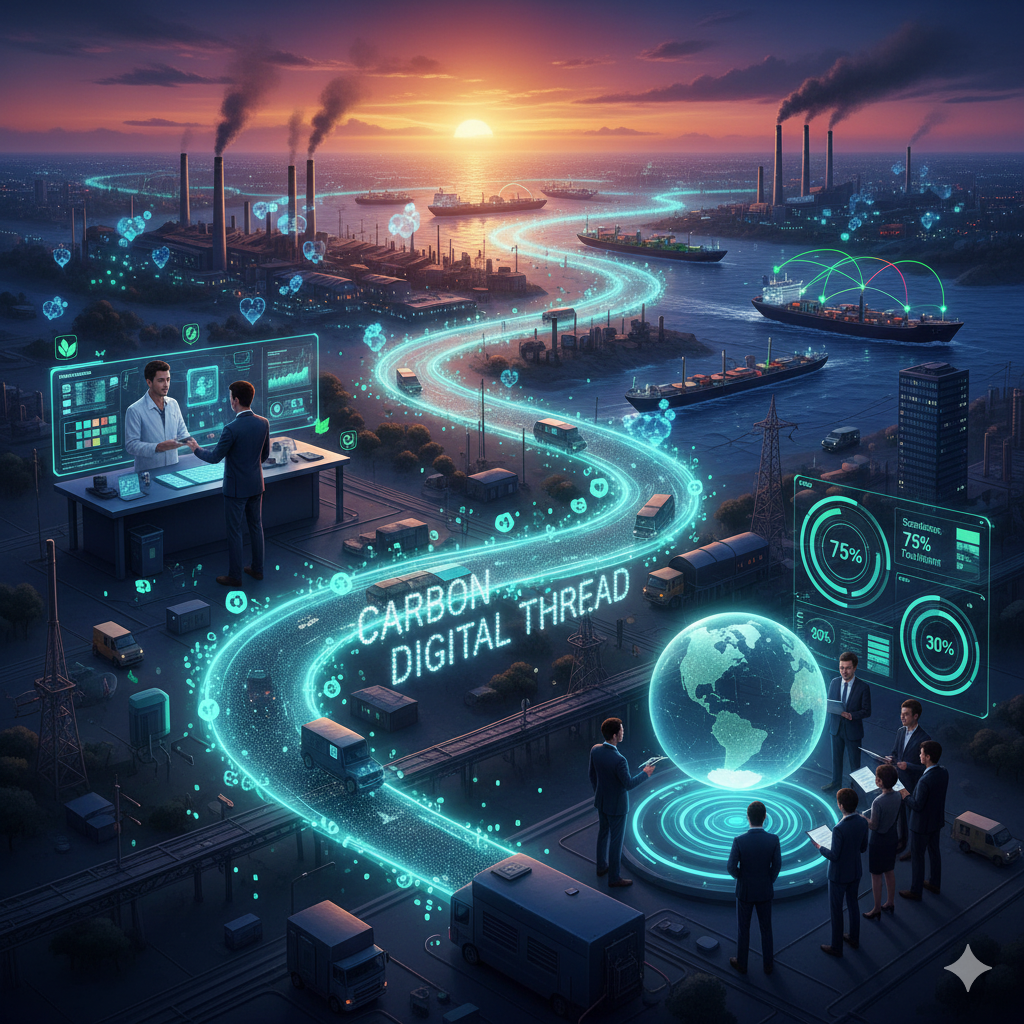
Imagine a continuous, connected data flow that links every stage of your product’s lifecycle – from initial design and material selection, through manufacturing and logistics, all the way to end-of-life. This isn’t just about sharing CAD files; it’s about sharing contextual data at every touchpoint.
When it comes to Scope 3 emissions, the Digital Thread acts like a pair of X-ray glasses, allowing you to “see” the carbon footprint embedded in every decision and every transaction across your entire value chain.
How It Works in Practice:
- Design & Material Selection:
- Old Way: Engineers pick materials based on performance and cost.
- Digital Thread Way: PLM (Product Lifecycle Management) systems, connected to environmental databases, can show the embodied carbon footprint of different material choices at the design stage. An engineer can see that choosing recycled aluminum over virgin aluminum reduces emissions by X amount, or that a lighter design reduces transport emissions.
- Supplier Collaboration & Procurement:
- Old Way: You pick suppliers based on price, quality, and delivery.
- Digital Thread Way: Your supply chain platform, integrated with PLM and ERP, can include supplier sustainability data (e.g., their energy mix, waste reduction efforts, certifications). You can model the impact of choosing a local supplier versus an overseas one, or a supplier using renewable energy versus fossil fuels. This data becomes a legitimate factor in procurement decisions.
- Manufacturing & Production:
- Old Way: Focus on manufacturing efficiency (cost, speed).
- Digital Thread Way: Connect your factory’s energy consumption data, waste generation, and water usage to the specific products being made. If a product requires a high-energy process, that footprint is linked directly to its digital twin. Optimizing production processes can now also be driven by carbon reduction goals.
- Logistics & Transportation:
- Old Way: Ship products via the cheapest or fastest route.
- Digital Thread Way: Integration with logistics platforms allows you to track not just delivery times, but also the carbon intensity of different shipping methods (sea freight vs. air freight), routes, and carriers. This can help identify optimal “green” routes.
- Product Use & End-of-Life:
- Old Way: Design for function, with little thought to disposal.
- Digital Thread Way: Design for circularity. Data from product usage (e.g., energy consumption during operation) and repair/recycling pathways can feed back into the design process. Products are designed from the outset to be easily disassembled and recycled, with their material composition tracked from cradle to grave.
The Benefits Beyond “Being Green”
While environmental stewardship is the primary driver, the Digital Thread approach to Scope 3 emissions offers tangible business advantages:
- Risk Mitigation: Proactive identification of high-emission suppliers or processes reduces exposure to future carbon taxes, regulations, and reputational damage.
- Cost Savings: Optimizing material choices, logistics, and manufacturing processes often leads to reduced waste, lower energy consumption, and more efficient resource use.
- Enhanced Innovation: Integrating sustainability into design forces innovation in materials, processes, and product lifecycles.
- Improved Brand Reputation: Demonstrable commitment to sustainability resonates with environmentally conscious customers and investors.
- Competitive Advantage: Companies with transparent, verifiable Scope 3 data will stand out in an increasingly demanding market.
Taking the First Step: It’s a Journey, Not a Destination
Implementing a full Digital Thread for Scope 3 emissions is a significant undertaking. It requires integrating disparate systems, collaborating deeply with suppliers, and fostering a culture of data sharing.
But you don’t have to overhaul everything overnight. Start small:
- Identify High-Impact Areas: Where are your biggest Scope 3 emissions likely coming from? Focus there first.
- Engage Key Suppliers: Start a dialogue. Many suppliers are also looking to improve their own sustainability and may already have some data.
- Leverage Existing Systems: Look for ways to connect data you already have in PLM, ERP, and supply chain management tools.
- Invest in Data Standardization: Work towards common metrics and reporting formats across your value chain.
The era of “out of sight, out of mind” for Scope 3 emissions is rapidly coming to an end. The Digital Thread isn’t just a technological marvel; it’s an essential tool for unlocking the visibility and control needed to navigate a sustainable future. It’s how we move from guessing about our impact to genuinely understanding, measuring, and ultimately reducing the invisible giants of our supply chain’s carbon footprint.