Digital Transformation of the Sustainable Aviation Fuel Value Chain: The Strategic Role of Product Lifecycle Management in Aerospace Decarbonization
The global aerospace sector is currently navigating an unprecedented transition as it aligns with the ambitious target of achieving net-zero carbon emissions by 2050. This objective, primarily articulated through the “Fly Net Zero” resolution adopted by the International Air Transport Association (IATA) and supported by the International Civil Aviation Organization (ICAO), necessitates a multifaceted approach involving aerodynamic efficiency, lightweight structural design, and novel propulsion technologies.1 However, Sustainable Aviation Fuel (SAF) stands as the single most critical lever in this decarbonization strategy, projected to contribute approximately 65% of the required emission reductions needed for climate neutrality.1 Despite its potential, the transition from conventional Jet A-1 to SAF is characterized by extreme technical complexity, including feedstock variability, chemical compatibility challenges, and the rigorous demands of life cycle greenhouse gas (GHG) accounting.3
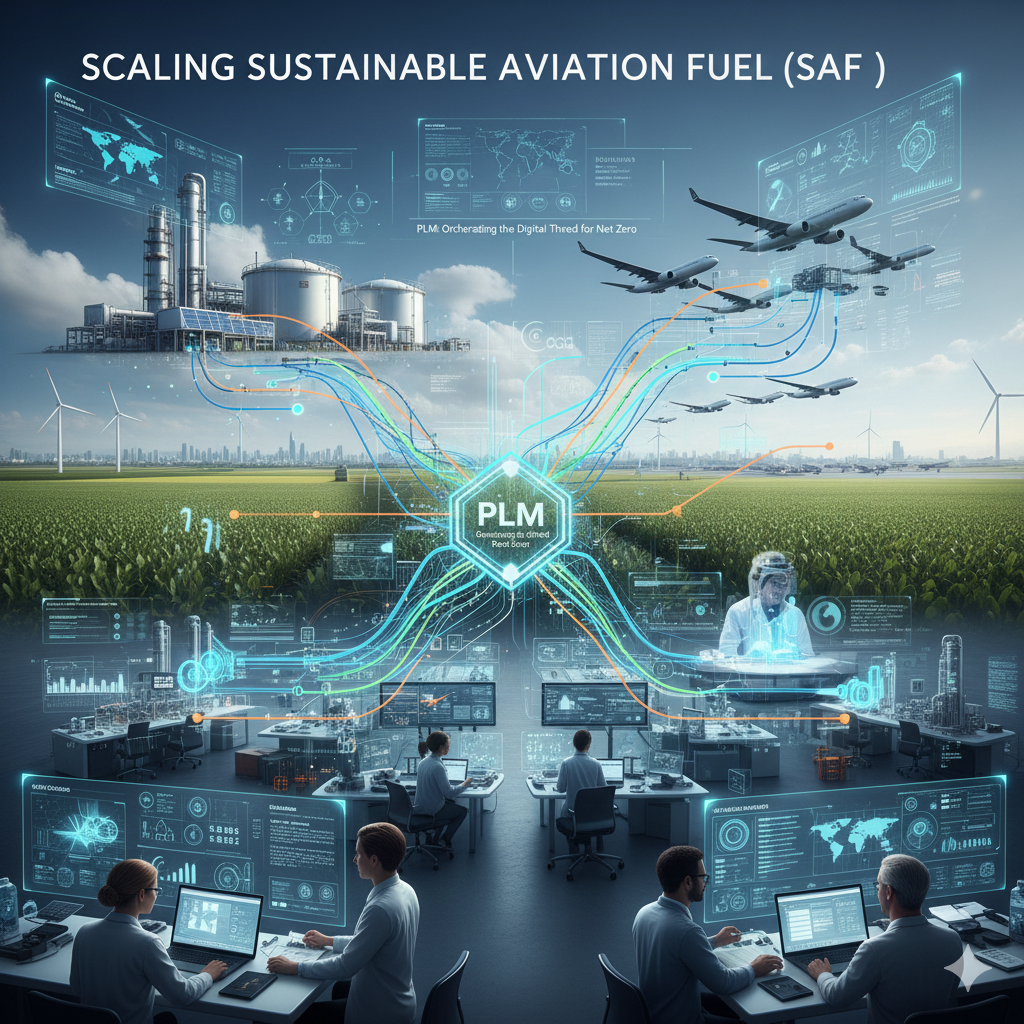
To manage this complexity, aerospace and defense (A&D) organizations are increasingly adopting Product Lifecycle Management (PLM) systems as the primary digital orchestrator for SAF research and adoption. Traditionally utilized for managing mechanical assemblies and electronic subsystems, modern PLM is evolving into a comprehensive “digital thread” that connects molecular-level fuel research with aircraft performance, airworthiness certification, and operational sustainability.6 By creating an authoritative single source of truth, PLM enables the industry to bridge the gap between small-batch laboratory testing and the multi-million-tonne industrial scaling required to meet the 2050 mandate.3
The SAF Imperative and the Limitations of Current Production Landscapes
Sustainable Aviation Fuel represents a class of alternative fuels produced from non-petroleum renewable feedstocks, including biomass, waste oils, and captured carbon dioxide.8 These fuels are designed as “drop-in” solutions, meaning they must achieve essentially identical physicochemical properties to conventional petroleum-derived fuels to be employed seamlessly without modifications to existing aero-engines, aircraft, or refueling infrastructure.12 The environmental value proposition of SAF is profound; depending on the production pathway, it can reduce life-cycle emissions by up to 99% compared to traditional jet fuel.3
However, the current market reality is one of extreme scarcity. In 2023, SAF production accounted for only 0.2% of global jet fuel use, approximately 600 million liters.3 Scaling this to the 500 million tonnes required by 2050 represents a massive industrial challenge that is further complicated by the diverse array of production technologies and the inherent volatility of renewable feedstocks.3
Comparative Technical Analysis of Approved SAF Production Pathways
The variability in SAF performance and its subsequent integration into the aerospace lifecycle is primarily determined by the conversion technology and the raw material inputs. PLM systems must manage this variability as a complex set of “product configurations” to ensure that any batch of fuel utilized is compatible with the specific aircraft tail-numbers it serves.6
| SAF Production Pathway | Principal Feedstocks | Maximum Blending Limit | Standard Density (g/cm3) | Standard Freezing Point (∘C) | Key Maturity Barrier |
| HEFA-SPK | Used cooking oil, animal fats, vegetable oils | 50% | 0.760 | -47 | Feedstock scarcity and global supply bottlenecks 10 |
| FT-SPK | Lignocellulosic biomass, MSW, agricultural residues | 50% | 0.750 | -50 | High CAPEX and complex gasification stages 10 |
| SIP | Sugarcane, sugar beet, and corn-based sugars | 10% | 0.805 | -30 | High freezing point limits blending ratios 10 |
| ATJ-SPK | Ethanol and butanol from waste or biomass | 50% | 0.757 | -80 | High energy intensity in multi-stage processing 3 |
| PtL (Power-to-Liquid) | Captured $CO_2$ and green hydrogen | 50% | 0.775–0.840 | -47 | High electricity costs and H2 availability 10 |
| RCF (Recycled Carbon) | Plastic waste and industrial gas emissions | TBD | 0.775–0.840 | -47 | Immature regulatory and certification frameworks 10 |
The technical diversity highlighted in the production pathways necessitates a digital framework capable of managing not only the physical components of the aircraft but also the “chemical components” of its fuel. For example, the Synthetic Iso-Paraffinic (SIP) pathway, while chemically viable, is constrained by a $-30^{\circ}C$ freezing point, which creates significant operational risks for high-altitude, long-haul flights where fuel temperature can drop below this threshold.10 A PLM system enables airlines to manage these risks by linking fuel batch properties to specific flight routes and environmental conditions, effectively treating fuel as a dynamic part of the aircraft’s configuration.6
Leveraging PLM for Advanced SAF Research and Molecular Modeling
The research phase of SAF development is uniquely burdened by the heterogeneity of renewable feedstocks. Unlike the relatively stable chemical profile of petroleum-derived crudes, SAF feedstocks such as used cooking oil (UCO) or municipal solid waste (MSW) exhibit significant variability in their molecular composition based on origin, season, and collection method.5 PLM systems, integrated with specialized chemical design and process modeling tools, provide the framework necessary to manage this variability and accelerate the transition from laboratory discovery to ASTM certification.8
Digital Process Twins and High-Fidelity Physics-Based Modeling
The emergence of “Digital Process Twins” within the PLM environment represents a paradigm shift in fuel research. Siemens gPROMS, a core component of the Siemens Xcelerator portfolio, allows researchers to create mechanistic models that accurately represent the entire sustainable fuel process.1 These models go beyond traditional flowsheets by incorporating high-fidelity physics and chemical kinetics, enabling engineers to predict the behavior of novel catalysts and reaction pathways with high precision.19
For organizations like the Southwest Research Institute (SwRI), which supports SAF R&D programs through jet engine fuel testing and sector combustor analysis, the integration of physical test data into a PLM digital twin is essential.8 The ability of gPROMS to seamlessly integrate experimental or plant data for model calibration ensures that the virtual designs accurately reflect real-world outcomes.19 This capability significantly de-risks investments in new refining facilities by allowing for “virtual experimentation” and Global Sensitivity Analysis (GSA) to identify optimal process configurations before any physical infrastructure is built.19
AI and Scientific Intelligence in Formulation Management
The integration of Artificial Intelligence (AI) and Machine Learning (ML) into the PLM stack is accelerating the optimization of feedstock combinations. Modern PLM platforms for the chemical industry, such as Chemcopilot, utilize AI-native tools to analyze complex relationships in feedstock data and predict energy yields and emissions profiles.18 These systems act as “engineering copilots,” transforming trial-and-error laboratory practices into predictable outcomes by leveraging historic and current data, including Bills of Materials (BoM) and reactor process logs.18
By utilizing reinforcement learning (RL) and multi-layered models, AI-driven PLM systems can dynamically optimize feedstock blends in real-time. Research suggests that such AI-powered optimization can increase energy output by 15–20% while reducing production costs by 15–25%.5 This level of operational efficiency is critical for making SAF economically viable, as the “green premium” over conventional jet fuel remains a significant barrier to airline adoption.3
Solving the Aromatic Gap: Material Compatibility and Elastomer Reliability
One of the most critical technical challenges in SAF adoption is the “Aromatic Gap.” Conventional Jet A-1 contains approximately 17% aromatic hydrocarbons, which perform a vital functional role by swelling elastomeric seals and O-rings in aircraft fuel systems to ensure leak-proof connections.23 Many leading SAF pathways, particularly HEFA-SPK and ATJ-SPK, are paraffinic and contain virtually zero aromatics.23 When an aircraft transitions to 100% SAF, the resulting shrinkage of existing nitrile-based seals can lead to catastrophic fuel leaks and engine failure.23
PLM-Managed Material Compatibility Testing
To address this airworthiness risk, PLM systems are being utilized to manage extensive material science databases that correlate fuel chemistry with elastomer performance. Researchers at organizations like SwRI and EnviroTREC utilize dedicated instrumentation to evaluate physical properties such as volume swell, tensile strength, and hardness after extended immersion in various SAF blends.24
| Elastomer Compound | Base Material | Swell in Jet A (17% Aromatics) | Swell/Shrink in 100% HEFA/ATJ | PLM Application Context |
| N1059 / N674 | Nitrile Rubber (NBR) | 14% to 26% Swell | Significant Shrinkage / 0% Swell | Legacy system risk assessment 23 |
| V747 / V884 | Fluorocarbon (FKM) | Modest Swell | Minimal Interaction | High-temp seal validation 25 |
| LM100-70 | Fluorosilicone (FVMQ) | Modest Shrinkage | Uniform Modest Shrinkage | Predictive performance modeling 23 |
The data reveals that while nitrile elastomers—the industry standard for decades—are highly sensitive to aromatic content, fluorosilicone (FVMQ) offers a more consistent response across diverse fuel types.23 Within the PLM framework, these test results are linked to the aircraft’s “digital twin,” allowing engineers to simulate the long-term impact of “switch-loading” between Jet A and SAF.23 This enables a shift from reactive maintenance to prognostic health monitoring, where the replacement of critical seals is triggered by a digital calculation of cumulative chemical exposure rather than a generic time-based interval.28
Life Cycle Assessment and the Carbon Intensity Reporting Framework
The primary value proposition of SAF is its ability to reduce lifecycle greenhouse gas emissions. However, the calculation of this reduction is highly complex, requiring an audit of the entire value chain—from the fertilizer used in feedstock cultivation to the energy intensity of the refining process and the final combustion emissions.4 PLM systems integrated with Life Cycle Assessment (LCA) tools are essential for managing this “environmental bill of materials” and ensuring regulatory compliance with frameworks such as CORSIA and the EU Renewable Energy Directive (EU RED).32
Sustainable Innovation Intelligence on the 3DEXPERIENCE Platform
Dassault Systèmes has integrated LCA capabilities directly into its 3DEXPERIENCE platform through its “Sustainable Innovation Intelligence” solution.35 By embedding the ecoinvent database—the world’s leading life cycle inventory (LCI) source—into the virtual design environment, the platform allows engineers to assess environmental impacts early in the development cycle.36 This is a critical advancement, as it is estimated that 80% of a product’s environmental impact is locked in during the initial design phase.38
The LCA module allows companies to quantify carbon emissions, water use, and land-use impacts for any given fuel formulation.31 For an aerospace manufacturer, this means they can virtually test different engine/fuel combinations to identify the optimal trade-off between fuel efficiency and total carbon footprint.31 This is particularly relevant for complying with the U.S. Department of the Treasury’s 40B SAF tax credit, which requires rigorous documentation of supply chain traceability and GHG emissions calculated via the GREET model.34
Case Study: SAF Production Routes in Colombia
A comprehensive LCA conducted for SAF production in Colombia using SimaPro software illustrates the necessity of granular data tracking within a PLM system.40 The study evaluated three pathways: Alcohol-to-Jet (ATJ) from Pinus Patula, Fischer-Tropsch (FT) from palm oil waste, and HEFA from used cooking oil.
| Pathway Impact Analysis | GW (Global Warming) Critical Point | AC (Acidification) Critical Point | WS (Water Scarcity) Critical Point |
| ATJ Route | 99.7% from Hydrogen supply | High dependency on chemical inputs | Low overall impact |
| FT Route | Synthesis heat intensity | 99.97% from fossil Hydrogen | Moderate |
| HEFA Route | Heat requirements (79.6%) | Final product characteristics | 77.13% from Synthesis heat |
The analysis identified that for the ATJ and FT routes, the use of hydrogen produced from fossil fuels accounted for nearly the entire global warming impact.40 This finding highlights a critical “hotspot” for engineers: to achieve true sustainability, the SAF digital thread must extend to the sourcing of green hydrogen.1 PLM systems enable this holistic view by connecting the fuel refinery’s digital twin with the renewable energy grid’s data, ensuring that “sustainability” is not lost in a fragmented supply chain.1
Configuration Management and the Digital Thread in Aerospace Manufacturing
The transition to SAF is occurring concurrently with the introduction of other disruptive technologies, such as hydrogen propulsion and electric flight. This creates a highly volatile configuration management landscape where an aircraft must be certified for multiple fuel types across its 30-year lifecycle.1 The “digital thread” created through PLM implementation provides the necessary traceability from requirement specification through design, manufacturing, and maintenance.6
Managing Complex Assemblies and Regulatory Evidence
Aerospace products are characterized by extraordinarily long lifecycles and multilayered supply chains.6 PLM systems serve as the backbone for orchestrating these complex assemblies, ensuring that the “as-built” configuration matches the “as-certified” safety standards.6 For SAF adoption, this means the PLM must maintain a record of every component in the fuel system that has been validated for specific SAF blending ratios (e.g., 50% vs. 100%).8
| PLM Core Capability | Application to SAF Transition | Strategic Outcome |
| Configuration Control | Tracking SAF-compatible parts (O-rings, pumps) | Prevents airworthiness violations during fuel swaps 6 |
| Requirements Traceability | Linking ASTM D7566 standards to engine design | Ensures fuel-engine performance alignment 6 |
| Change Management | Formal workflows for fuel system modifications | Reduces engineering errors in seal replacements 6 |
| Supplier Integration | Synchronizing fuel chemistry data with engine OEMs | Enhances supply chain visibility and safety 6 |
The importance of this digital continuity is illustrated by the historical comparison between the Airbus A380 and the Boeing 787. In the case of the A380, incompatible CAD systems led to electrical wiring harnesses not fitting the aircraft body, resulting in a $6 billion loss and a two-year delay.43 In contrast, the Boeing 787 utilized a more centralized PLM approach with strict rules for data integrity, leading to significant profits and shorter time-to-market.43 For the SAF transition, the Aerospace & Defense PLM Action Group (AD PAG)—including members like Boeing, Airbus, and GE Aerospace—is now standardizing the “digital thread” to avoid similar bottlenecks in the decarbonization journey.42
Operational Optimization and Predictive Maintenance via Digital Twins
Once an aircraft enters service, the PLM system’s role shifts to performance monitoring and fleet management. Digital twins allow operators to monitor every aspect of an aircraft’s performance with precision, integrating real-time data from sensors to mirror current conditions and simulate future scenarios.28
Prognostic Health Monitoring (PHM) for SAF-Fueled Fleets
The use of SAF has the potential to improve engine longevity due to reduced particulate matter and sulfur emissions, which contribute to cleaner internal components.10 However, the “aromatic gap” remains a concern for static and dynamic seals. Digital twins utilize advanced analytics and machine learning to detect early signs of potential issues, such as abnormal vibrations or temperature fluctuations in the fuel system, that signal the need for preventive maintenance.28
This data-driven approach promotes sustainability by reducing unnecessary part replacements and maximizing the operational lifespan of components.2 For airlines, this translates to significant cost savings and reduced downtime—a critical advantage given the high operational costs associated with SAF procurement.3
Virtual Certification and Regulatory Support
The traditional certification process for a new aviation fuel is expensive and time-consuming, often requiring years of physical testing.8 Digital twin technology offers a shift toward “virtual certification,” where performance can be simulated under a broad range of edge cases that are difficult or risky to test physically.2
Regulatory bodies like EASA and the FAA are increasingly open to using digital twin data as evidence for structural resilience and environmental performance.1 Within the PLM framework, this virtual evidence is stored as part of the “Compliance Evidence” package, allowing for faster approval of higher SAF blending ratios and new production pathways.6 This capability is essential for meeting the EU’s “Fit for 55” mandate, which requires SAF blending obligations to reach 70% by 2050.10
Future Strategic Outlook: The Unified Digital Infrastructure for Net Zero
As the aerospace industry intensifies its research into hydrogen aviation and smart manufacturing, PLM systems will serve as the integrative platform that unifies simulation, decision-making, and regulatory compliance.2 The framework for a sustainable aviation transition encompasses six interrelated domains where digital twins deliver the most significant impact: fuel and propulsion, lifecycle sustainability assessment (LCSA), certification support, sustainable airframe design, operational optimization, and end-of-life management.2
The Role of Digital Product Passports
Looking toward 2030, the concept of a “Digital Product Passport” (DPP) is moving from theory to implementation. These passports, managed within the PLM digital thread, will provide a complete record of a fuel’s environmental impact, starting from the design and supplier decisions that shaped its outcome.38 For aerospace companies, this means the ability to meet emerging EU expectations with fewer bottlenecks and greater confidence during audits.38
The “environmental intelligence” embedded in the PLM will allow organizations to not only measure their current footprint but also the impact of future decisions.31 By virtualizing the “multiple cycles of lives of things,” the industry can move toward a generative economy where waste is transformed into a resource, and every flight is powered by a fuel that is as digitally verified as the aircraft it propels.35
Strategic Conclusions for Aerospace Leaders
The analysis of the SAF research and adoption landscape indicates that digital transformation is not merely a tool for efficiency but a foundational requirement for survival in a carbon-constrained market. To achieve the 2050 net-zero goals, aerospace companies must:
- Adopt Physics-Based Digital Process Twins: Utilizing platforms like Siemens gPROMS allows for the de-risking of new fuel production technologies and the optimization of feedstock usage, reducing the “green premium” and accelerating market entry.19
- Integrate LCA into the Design Workflow: Embedding life cycle assessment tools like those on the Dassault 3DEXPERIENCE platform ensures that sustainability is an inherent part of the engineering process rather than an afterthought.35
- Prioritize the Digital Thread for Configuration Management: Maintaining a continuous flow of information from fuel chemistry to seal compatibility ensures fleet safety and airworthiness during the transition from 50% to 100% SAF blending.6
- Leverage AI for Predictive Compliance: Specialized AI agents, such as those in Chemcopilot, bridge the gap between scientific innovation and the strict regulatory frameworks of the aerospace industry.18
The transition to Sustainable Aviation Fuel is a Herculean task that requires the synchronization of multiple industries, from agriculture to chemical refining to high-end aerospace engineering. Product Lifecycle Management provides the only framework capable of orchestrating this complexity. By creating a unified digital reality where molecules, materials, and machines are managed as a single ecosystem, the aerospace industry can navigate the turbulence of decarbonization and reach the destination of climate neutrality. The digital thread is no longer an optional investment; it is the infrastructure upon which the future of flight will be built.
References
Works cited
- Sustainable Aviation | Clean Aviation | Siemens | Siemens Software, accessed January 2, 2026, https://resources.sw.siemens.com/en-US/white-paper-aerospace-defense-sustainable-aviation-by-2050/
- (PDF) The role of digital twin technology in enhancing sustainable …, accessed January 2, 2026, https://www.researchgate.net/publication/398034816_The_role_of_digital_twin_technology_in_enhancing_sustainable_aviation_transition_A_state-of-the-art_review_and_future_direction
- Sustainable aviation fuels case study – Emis Vito, accessed January 2, 2026, https://emis.vito.be/sites/emis/files/2025-10/Sustainable%20aviation%20fuels%20case%20study.pdf
- Life Cycle Assessment for Sustainable Aviation Fuel (SAF) – P6 Technologies, accessed January 2, 2026, https://p6technologies.com/lca-saf/
- AI-POWERED FEEDSTOCK OPTIMIZATION IN SUSTAINABLE AVIATION FUEL PRODUCTION: ENHANCING EFFICIENCY AND REDUCING COSTS, accessed January 2, 2026, https://www.ijarcs.info/index.php/Ijarcs/article/view/7334/5935
- Strategic implementation of PLM systems in aerospace and defense …, accessed January 2, 2026, http://journalwjaets.com/sites/default/files/fulltext_pdf/WJAETS-2025-0984.pdf
- How to Test and Maintain PLM in Aerospace and Defense | Keysight Blogs, accessed January 2, 2026, https://www.keysight.com/blogs/en/tech/software-testing/plm-aerospace-and-defense
- Sustainable Aviation Fuel Research | Southwest Research Institute, accessed January 2, 2026, https://www.swri.org/markets/chemistry-materials/chemistry-chemical-engineering/process-engineering-fuels/sustainable-aviation-fuel-research
- Case Study: Modeling Critical Digital Threads between Authoritative Source of Truth (ASoT) Systems, accessed January 2, 2026, https://gpdisonline.com/wp-content/uploads/2024/10/NGC-DennisBeeson-Modeling-Critical-Digital-Threads-MBSE-open_APPROVED_NG24-18151.pdf
- Progress and Prospects of Sustainable Aviation Fuel … – MDPI, accessed January 2, 2026, https://www.mdpi.com/1996-1073/18/12/3154
- Global Feedstock Assessment for SAF Production – Outlook to 2050 – IATA, accessed January 2, 2026, https://www.iata.org/globalassets/iata/publications/sustainability/global-feedstock-assessment-for-saf-production-outlook-to-2050.pdf
- Sustainable Aviation Fuel | SAF – SkyNRG, accessed January 2, 2026, https://skynrg.com/sustainable-aviation-fuel/
- Discussion of the Standards System for Sustainable Aviation Fuels: An Aero-Engine Safety Perspective – MDPI, accessed January 2, 2026, https://www.mdpi.com/2071-1050/15/24/16905
- Sustainable Aviation Fuel: Compatibility, Safety, and Scientific Understanding, accessed January 2, 2026, https://www.greentechworld.sg/sustainable-aviation-fuel-compatibility-safety-and-scientific-understanding/
- Making sustainable fuels and feedstocks production scalable and efficient – Digital Asset Management – Siemens, accessed January 2, 2026, https://assets.new.siemens.com/siemens/assets/api/uuid:e2262b29-619e-4851-91ca-7ef62a1a715a/Midlevel-Presentation-Sustainable-Fuels-and-Feedstocks_original.pdf
- Best Product Lifecycle Management for Aerospace Industry – ComplianceQuest, accessed January 2, 2026, https://www.compliancequest.com/bloglet/product-lifecycle-management-for-aerospace-industry/
- Rethinking feedstocks for sustainable aviation fuel, accessed January 2, 2026, https://www.sustainableaviationfutures.com/saf-spotlight/pa-feg-feedstocks
- Product Lifecycle Management (PLM) in the Chemistry Industry …, accessed January 2, 2026, https://www.chemcopilot.com/blog/product-lifecycle-management-plm-in-the-chemistry-industry
- Accelerating Sustainable Fuels & Feedstocks via Digital Design, accessed January 2, 2026, https://www.sustainableaviationfutures.com/saf-spotlight/siemens-digitaltwin
- Siemens · Brochure template – Digital Asset Management, accessed January 2, 2026, https://assets.new.siemens.com/siemens/assets/api/uuid:2baa8550-6cc9-41ae-ad5a-d18fac43d264/Accelerating-Sustainable-Fuels-Feedstocks-Brochure.pdf
- AI-POWERED FEEDSTOCK OPTIMIZATION IN SUSTAINABLE AVIATION FUEL PRODUCTION: ENHANCING EFFICIENCY AND REDUCING COSTS – ResearchGate, accessed January 2, 2026, https://www.researchgate.net/publication/396926884_AI-POWERED_FEEDSTOCK_OPTIMIZATION_IN_SUSTAINABLE_AVIATION_FUEL_PRODUCTION_ENHANCING_EFFICIENCY_AND_REDUCING_COSTS
- Sustainable Aviation Fuel (SAF) Procurement Challenges – Journal of Information Systems Engineering and Management, accessed January 2, 2026, https://jisem-journal.com/index.php/journal/article/download/9420/4347/15697
- Understanding Elastomer Compatibility with Sustainable Aviation Fuels – EnviroTREC, accessed January 2, 2026, https://www.envirotrec.ca/2025/understanding-elastomer-compatibility-with-sustainable-aviation-fuels/
- Material Compatibility | Southwest Research Institute, accessed January 2, 2026, https://www.swri.org/markets/automotive-transportation/fuels-lubricants/filtration-contamination/material-compatibility
- Research on the Material Compatibility of Elastomer Sealing O-Rings – PMC – NIH, accessed January 2, 2026, https://pmc.ncbi.nlm.nih.gov/articles/PMC9414156/
- Elastomer-Based Sealing O-Rings and Their Compatibility with Methanol, Ethanol, and Hydrotreated Vegetable Oil for Fueling Internal Combustion Engines – MDPI, accessed January 2, 2026, https://www.mdpi.com/1996-1944/17/2/430
- Elastomer Compatibility Testing of Renewable Diesel Fuels – Publications, accessed January 2, 2026, https://docs.nrel.gov/docs/fy06osti/38834.pdf
- Digital Twins for Aerospace and Aircraft Development – ATT Metrology, accessed January 2, 2026, https://www.attinc.com/news/digital-twins-for-aerospace-and-aircraft-development/
- The Role of Digital Twin in Aerospace To Enhance Safety and Efficiency – Appinventiv, accessed January 2, 2026, https://appinventiv.com/blog/digital-twin-in-aerospace/
- Role of Digital Twins in the Automotive Industry: Revolutionizing Design, Production, and Performance – MarketsandMarkets, accessed January 2, 2026, https://www.marketsandmarkets.com/blog/SE/industry-reports-role-of-digital-twins-in-automotive-industry
- Life Cycle Assessment | Sustainability – Dassault Systèmes®, accessed January 2, 2026, https://www.3ds.com/sustainability/circular-economy/eco-design/lifecycle-assessment
- Sustainable Aviation Fuel 101: Certification – World Energy, accessed January 2, 2026, https://worldenergy.net/resource/saf-101-certification/
- Understanding SAF Sustainability Certification – IATA, accessed January 2, 2026, https://www.iata.org/contentassets/0bf212bfcb0548f2b6ad4c1e229f7e94/guidance-document-on-saf-sustainability-certification-v0.41_rm-indepth.pdf
- Guidelines to Determine Life Cycle Greenhouse Gas Emissions of Sustainable Aviation Fuel Production Pathways using 40BSAF-GREET 2024 – Department of Energy, accessed January 2, 2026, https://www.energy.gov/sites/default/files/2024-04/40bsaf-greet_user-manual.pdf
- What is PLM Software? Product Lifecycle Management …, accessed January 2, 2026, https://www.3ds.com/technologies/product-lifecycle-management
- Dassault Systèmes Introduces Life Cycle Assessment Solution on the 3DEXPERIENCE Platform – Automation.com, accessed January 2, 2026, https://www.automation.com/article/dassault-systemes-life-cycle-assessment-solution
- New Partnership with Dassault Systèmes – Ecoinvent, accessed January 2, 2026, https://ecoinvent.org/blog/we-are-proud-to-announce-our-new-partnership-with-dassault-systemes/
- Digital Thread in Aerospace and Defense eBook | Eurostep, accessed January 2, 2026, https://eurostep.com/digital-thread-in-aerospace-and-defense-ebook/
- Sustainability Innovation Platform – sustainability | 3DEXPERIENCE – Dassault Systèmes, accessed January 2, 2026, https://www.3ds.com/3dexperience/sustainability
- Life Cycle Assessment (LCA) of the Production of Sustainable …, accessed January 2, 2026, https://www.cetjournal.it/cet/25/117/058.pdf
- What Is PLM in Defense Manufacturing? – IFS, accessed January 2, 2026, https://www.ifs.com/what-is/plm-in-defense-manufacturing
- How the Digital Thread is Revolutionising the Defence and Aerospace Sector – OpsHub, accessed January 2, 2026, https://www.opshub.com/blogs/how-the-digital-thread-is-revolutionising-the-defence-and-aerospace-sector/
- An Analysis of Design and Digital Manufacturing Processes in a PLM Environment for the Aerospace Industry | Request PDF – ResearchGate, accessed January 2, 2026, https://www.researchgate.net/publication/267493796_An_Analysis_of_Design_and_Digital_Manufacturing_Processes_in_a_PLM_Environment_for_the_Aerospace_Industry
- Aerospace PLM Action Group Validates Digital Twin Investments, accessed January 2, 2026, https://www.digitalengineering247.com/article/aerospace-plm-action-group-validates-digital-twin-investments
- Digital Twins: Accelerating aerospace innovation from design to operations – Airbus, accessed January 2, 2026, https://www.airbus.com/en/newsroom/stories/2025-04-digital-twins-accelerating-aerospace-innovation-from-design-to-operations