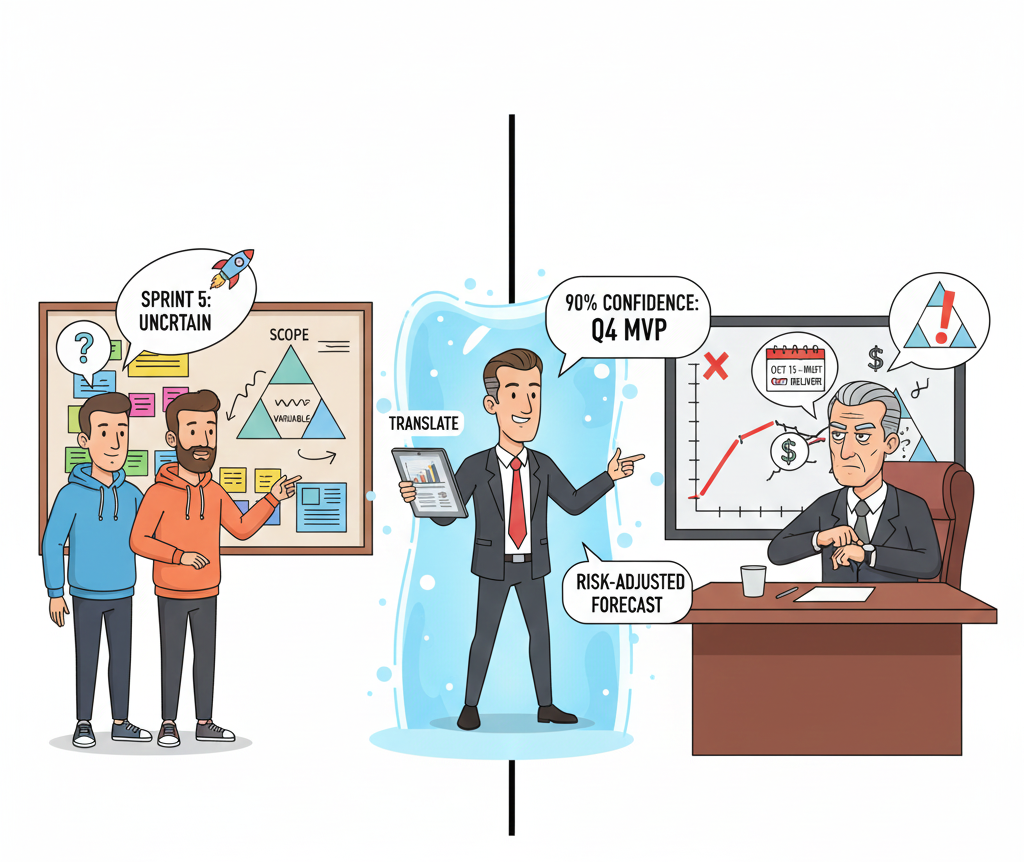
The transition to Agile often hits a brick wall not at the developer’s desk, but in the boardroom. For leaders raised on the predictability of Waterfall, the word “uncertainty” sounds like a lack of planning, and a “flexible timeline” sounds like an excuse for a late delivery. To bridge this gap, you must master the art of “Managing Up”—the ability to translate Agile’s iterative reality into the language of business value, risk mitigation, and strategic outcomes.
The most significant friction point is usually the concept of the “Fixed Scope.” Traditional stakeholders are used to seeing a Gantt chart that promises exactly what will be delivered six months from now. In Agile, we acknowledge that we don’t know what we don’t know. To explain this, stop focusing on “tasks” and start focusing on “outcomes.” Instead of promising a specific list of 50 features, talk about the “Problem to be Solved.” Explain that while the specific features may evolve based on user data, the commitment to solving the core business problem remains fixed.
One of the best ways to visualize this for a traditional stakeholder is through the Agile Iron Triangle. In traditional projects, Scope, Cost, and Time are often all “fixed,” which inevitably leads to a crash in Quality. In Agile, we flip the triangle: Cost and Time (Sprints and Budget) are fixed, but the Scope is the variable. This ensures that the most valuable work is always finished first, protecting the project from the “all-or-nothing” failure typical of Waterfall projects.
When discussing timelines, replace the “Date Certain” with “Confidence Intervals.” A traditional stakeholder wants to hear “October 15th.” An Agile practitioner knows that’s a guess. Instead, provide a range based on team velocity: “Based on our current pace, we have a 90% confidence level of delivering the core MVP by October, and a 60% confidence level of including the secondary features.” This reframes uncertainty not as “we don’t know,” but as a data-driven risk assessment. It shifts the conversation from a deadline to a probability, which is a concept every business leader understands in the context of financial forecasting.
Finally, lean into the “Early and Often” value proposition. Traditional stakeholders fear uncertainty because, in Waterfall, you don’t see results until the very end. Remind them that Agile actually reduces risk by delivering a functional product every few weeks. Explain that by embracing uncertainty, the organization avoids the most expensive mistake of all: spending a year building a perfectly planned product that the market no longer wants. By managing expectations through transparency and data, you turn “uncertainty” from a scary buzzword into a competitive advantage.