For decades, we’ve lived in a world where our precious product data – the very DNA of our innovations – has been held hostage. Not maliciously, of course, but inadvertently locked within the confines of the applications that created it. Your CAD files were best opened in your CAD software, your BOMs resided most comfortably in your PLM system, and your manufacturing instructions felt safest in your ERP.
This tight coupling of data and application was, for a long time, the only way to ensure integrity and functionality. But in today’s rapidly evolving digital landscape, it’s become a significant bottleneck. It’s the digital equivalent of having your entire book collection permanently bound into the bookstore where you bought them – great for browsing there, terrible for sharing, moving, or reading on a different device.
The future of Product Lifecycle Management (PLM), and frankly, all enterprise software, lies in a radical but essential shift: separating data from applications. This isn’t just a technical tweak; it’s a philosophical revolution that promises true openness, flexibility, and accelerated innovation.
The Chains That Bind: The Problem with Tightly Coupled Systems
When data is inseparable from the application, a few painful realities emerge:
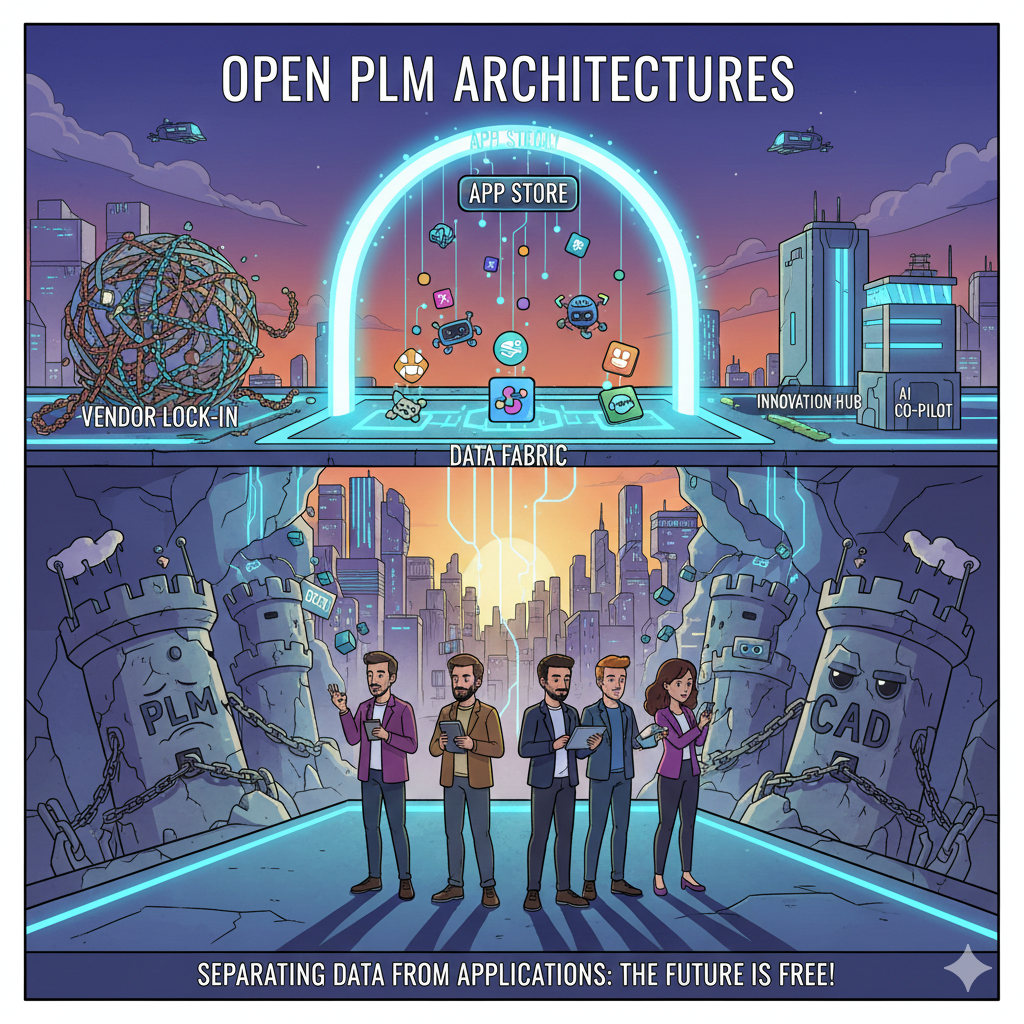
Vendor Lock-in: Want to switch CAD systems? Good luck extracting and translating decades of design data perfectly. Looking for a better PLM solution? The cost and risk of data migration can be astronomical. You’re essentially stuck, even if a superior solution emerges.
Integration Nightmares: Every time you need to connect your PLM to an ERP, a CRM, an MES, or a generative AI tool, you’re building bespoke bridges between two monolithic applications, hoping their underlying data models can somehow shake hands. It’s fragile, expensive, and often breaks with every update.
Limited Data Reusability: Your precious product data holds immense value beyond its original application. Could your marketing team leverage design visuals for immersive AR experiences? Could your service team use diagnostic data to predict failures? Not easily, if that data is trapped in an arcane database only accessible by one piece of software.
Slow Innovation: Imagine a brilliant new AI tool that could optimize your designs by 20%. If that tool can’t easily access and manipulate your core product data, its value is severely limited. Innovation is gated by the speed at which your legacy systems can adapt.
In essence, the tightly coupled architecture prevents your data from truly becoming a strategic asset. It makes your digital thread less of a seamless fabric and more of a tangled skein.
The Vision: Data as a Sovereign Entity
The alternative, and the future, is an architecture where data is treated as a sovereign entity, independent of the applications that create or consume it. Think of it like a universal library system, where every book (data) has a standardized format and an API (Application Programming Interface) for access, regardless of who wrote it or what device you want to read it on.
Here’s what this vision entails:
1. Standardized Data Models
Instead of each application having its own proprietary way of defining a “part” or an “assembly,” we move towards industry-standard data models. This allows different applications to speak a common language, making data inherently interoperable.
2. Open APIs and Data Services
Applications don’t directly “own” the data; they interact with it through well-defined, open APIs. This means any authorized application can access, modify, or add to the data, fostering a true ecosystem of tools.
3. Data Lakes/Fabric for Product Information
Instead of data living in isolated application databases, it resides in a centralized, structured data environment (a data lake or data fabric). This acts as the ultimate “single source of truth,” accessible and searchable by any authorized application or user.
4. The “App Store” for Engineering
Imagine being able to choose the best-in-breed application for each specific task – one for CAD, another for simulation, a third for project management – all seamlessly working with the same underlying product data. You’d have the flexibility to swap out tools as technology evolves, without fear of data loss or crippling migration costs.
The Untangling Process: How We Get There
This isn’t a flip-a-switch transformation. It’s a journey, but one that many forward-thinking companies and vendors are already embarking on.
Microservices Architecture: Breaking down monolithic applications into smaller, independent services that communicate via APIs. This allows individual components to be updated or swapped without affecting the whole system.
Graph Databases: These are particularly powerful for managing complex, interconnected product data, as they naturally represent relationships between parts, documents, and processes.
Industry Standards: Collaboration on open standards for data exchange (e.g., STEP, DEX, future ontology-driven standards) is crucial to facilitate interoperability.
Semantic Interoperability: Moving beyond just sharing data formats to sharing the meaning of that data. This ensures that when one application talks about a “revision,” another understands exactly what that implies.
Data Governance: With data liberation comes the need for robust governance – who has access, what changes are allowed, and how is integrity maintained across multiple consuming applications?
The Promise: What True Openness Unlocks
The benefits of separating data from applications are profound:
Unprecedented Flexibility: Choose the best tools for your specific needs, unconstrained by vendor ecosystems.
Accelerated Innovation: New technologies (like advanced AI/ML, AR/VR) can be integrated faster and more effectively, tapping directly into your core product data.
Reduced Cost and Risk: Lower integration costs, easier upgrades, and dramatically simplified migrations.
Empowered Collaboration: Seamless data flow across internal departments, external partners, and even customers, fostering a truly collaborative product development environment.
Data as a Strategic Asset: Your product data becomes liquid, flowing freely to inform decisions, drive new insights, and create entirely new business models.
The days of monolithic, tightly coupled PLM systems are numbered. The future is bright, open, and liberating. It’s a future where your data is no longer a prisoner of its past, but a free agent, ready to power the next wave of innovation.