Imagine you’re building something. Maybe it’s a new app, a marketing campaign, a physical product, or even a community event. Before you lay the first brick or write the first line of code, you have a crucial decision to make: how are you going to manage this project?
Agile vs Waterfall – For decades, one method dominated: Waterfall. It’s linear, sequential, and predictable. Then, a new contender emerged: Agile. It’s iterative, flexible, and adaptive. Both are powerful, but choosing the wrong one for your project can lead to wasted time, budget overruns, and frustrated teams.
This isn’t about declaring a “winner.” It’s about understanding which path is right for your specific journey. Let’s cut through the buzzwords and get down to brass tacks.
Understanding the Fundamentals: What Are We Talking About?
Before we compare Agile vs Waterfall, let’s define.
Waterfall: The Grand Blueprint Approach
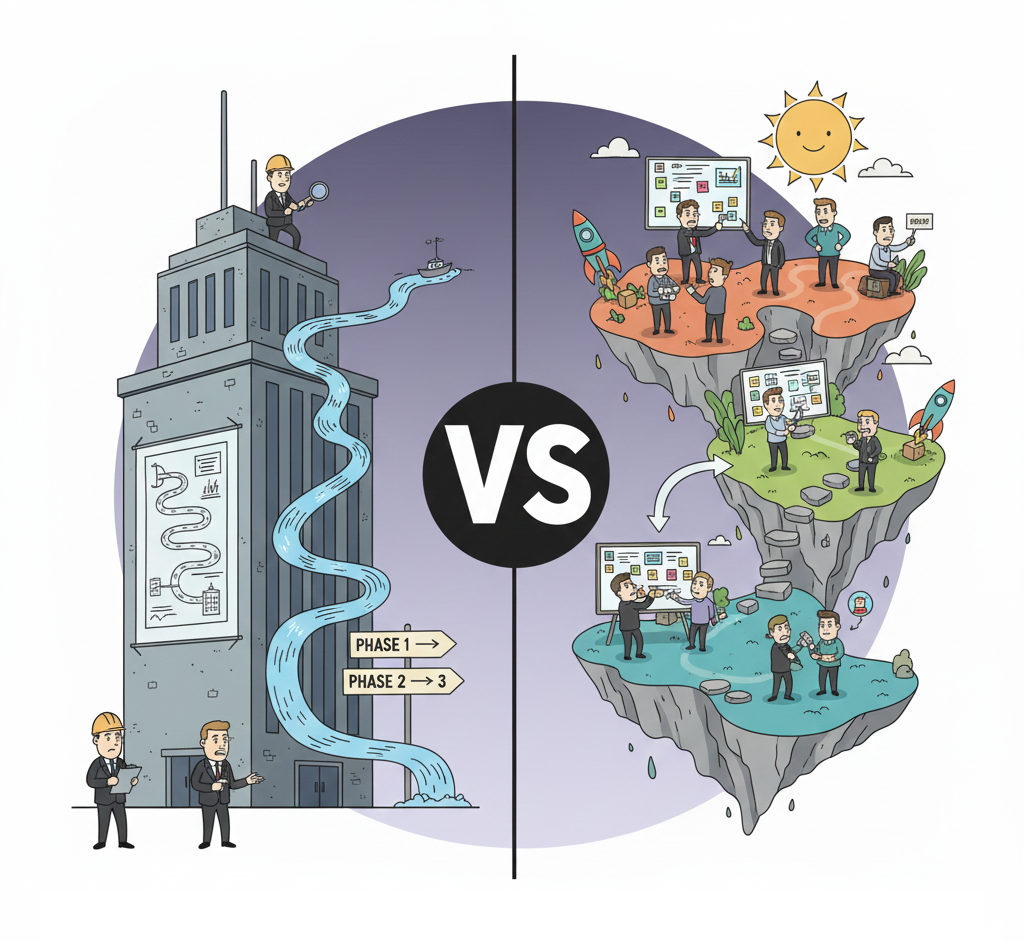
Think of Waterfall like building a house with a detailed blueprint. You design everything upfront: the foundation, the plumbing, the electrical, the roof. Each phase must be completed and signed off before the next one begins.
Key Characteristics:
- Sequential Phases: Requirements > Design > Implementation > Verification > Maintenance. No going back easily.
- Upfront Planning: All requirements are gathered and documented extensively at the beginning.
- Predictability: Aims for a fixed scope, budget, and timeline (though often struggles to achieve it in reality).
- Documentation-Heavy: Each phase produces extensive documentation.
- Clear Roles: Defined roles and responsibilities for each stage.
Where it Came From: Rooted in manufacturing and construction, where changes are incredibly costly once work has begun. It made its way into software development in the 1970s.
Agile: The Adaptive Journey Approach
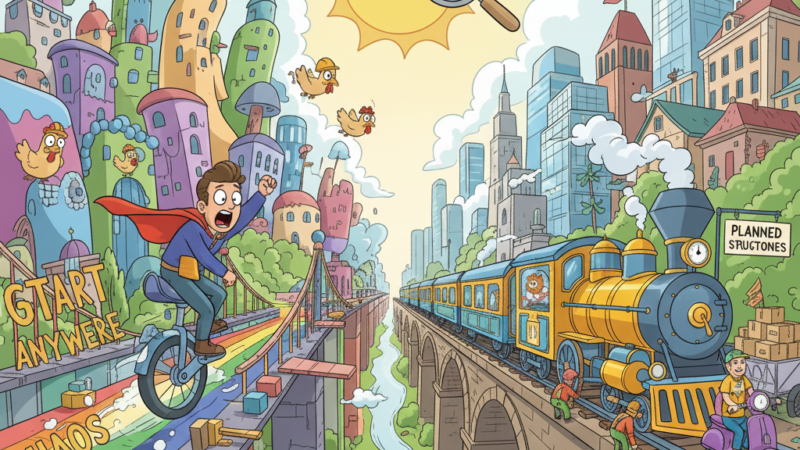
Now, imagine Agile as planning a road trip where you know your destination, but you’re open to exploring interesting detours, changing routes based on weather, and making frequent stops to check if everyone’s enjoying the ride. You plan in small chunks, constantly checking in and adjusting.
Key Characteristics:
- Iterative & Incremental: Work is broken down into small, fixed-time periods called “Sprints” (usually 1-4 weeks).
- Flexible & Adaptive: Embraces change and can easily pivot requirements based on feedback.
- Customer Collaboration: High emphasis on continuous feedback from the client/customer.
- Self-Organizing Teams: Empowered teams make decisions about how to best accomplish work.
- Working Software/Product: Focus on delivering small, functional pieces frequently, rather than waiting for a big bang at the end.
Where it Came From: Born from the frustrations of Waterfall in software development, captured in the Agile Manifesto in 2001, emphasizing individuals & interactions, working software, customer collaboration, and responding to change.
The Head-to-Head: When Does Each Shine?
Agile vs Waterfall – Neither method is inherently “better.” They are tools, and the best tool depends on the job.
Choose Waterfall When:
- Requirements are Stable and Well-Understood: You know exactly what you need from day one, and it’s highly unlikely to change. (Think regulatory projects, well-defined infrastructure upgrades).
- Analogy: Building a standard bridge. The physics don’t change, the river’s width is known, and the design needs to be precise upfront.
- The Project Has a Clear, Fixed End Goal: There’s little ambiguity about the final product.
- There’s a Strong Need for Extensive Upfront Documentation: Regulatory compliance, historical records, or highly standardized processes require detailed plans before execution begins.
- Team Members are Specialized and Work Sequentially: If one team absolutely must finish their part before the next can even start (e.g., architectural design then structural engineering then interior design).
- You Have Experience with Similar Projects: If you’ve built this exact type of thing before, the unknowns are minimal.
- The Environment is Predictable and Stable: Little external change (market, technology, regulations) is expected during the project lifecycle.
Example Use Cases: Construction, manufacturing (especially for standard products), large-scale infrastructure projects, highly regulated industries with strict compliance rules, simple and straightforward software development (rare these days).
Choose Agile When:
- Requirements are Evolving or Unclear: You know the general direction, but not the exact details. You expect to learn and adapt as you go.
- Analogy: Developing a new video game. You know the genre and core mechanics, but player feedback during development will heavily influence features and story.
- Customer Feedback is Crucial and Frequent: You need to show progress and get input from users regularly to ensure you’re building the right thing.
- Time-to-Market is Critical: You need to deliver value incrementally and quickly, rather than waiting for one big launch.
- Innovation and Experimentation are Key: The project involves new technologies, uncharted territory, or a need to discover the best solution through trial and error.
- The Project Team is Self-Motivated and Collaborative: Agile thrives on empowered teams who can make decisions and communicate effectively.
- The Environment is Volatile, Uncertain, Complex, and Ambiguous (VUCA): Most modern tech and business environments fit this description. Change is the only constant.
Example Use Cases: Software development (web apps, mobile apps, enterprise software), product development (new features, MVPs), marketing campaigns, R&D projects, startups, any project where learning and adaptation are expected.
The Hybrid Reality: It’s Not Always Black and White ( Agile vs Waterfall)
In the real world, many organizations find themselves somewhere in the middle. They might use Agile principles for the core development work but have a more Waterfall-like approach for broader project initiation, budgeting, or release management. This “Hybrid Agile” often occurs out of necessity as organizations transition or when external dependencies require a more predictable outlook.
When a Hybrid Approach Makes Sense:
- Large Organizations: Where internal departments operate differently.
- Hardware + Software Projects: The hardware component might be Waterfall-driven, while software is Agile.
- External Vendors: When dealing with partners who use a different methodology.
The key with hybrid approaches is to be intentional. Don’t let it become “Fake Agile” (as we discussed in a previous post!) where you get the worst of both worlds. Understand where you are genuinely sequential and where you can genuinely be adaptive.
Making Your Decision: A Simple Framework
Ask yourself these questions about your project:
- How well-defined are the requirements today?
- Very clear, stable, won’t change: Waterfall
- Known direction, but details will emerge: Agile
- Almost entirely unknown, need to discover: Strongly Agile (or even Lean Startup experimentation)
- How important is early, continuous customer/stakeholder feedback?
- Not critical until the very end: Waterfall
- Essential to guide development: Agile
- How much tolerance for change do we have during the project?
- Very little, changes are costly: Waterfall
- High tolerance, expect and embrace change: Agile
- What’s the desired time-to-market for initial value?
- One big launch at the end is fine: Waterfall
- Need to deliver small, working pieces quickly: Agile
- How experienced and self-organizing is the project team?
- Less experienced, needs clear direction: Waterfall (but consider Agile training for long-term benefit)
- Experienced, autonomous, collaborative: Agile
- What’s the risk profile?
- Low risk, well-understood domain: Waterfall
- High risk, complex domain, need to mitigate via frequent checks: Agile
The Bottom Line: Be Pragmatic, Not Dogmatic
The world is moving faster than ever. For most modern product development, especially in technology, Agile tends to be the superior choice because it’s built for complexity and change. It allows you to fail fast, learn faster, and deliver value continuously.
However, rigidly applying Agile where Waterfall is genuinely a better fit can be just as disastrous as trying to force Waterfall onto a complex, evolving project.
Your goal isn’t to be “Agile” for Agile’s sake, or “Waterfall” because “that’s how we’ve always done it.” Your goal is to successfully deliver your project, delight your stakeholders, and empower your team.
So, take a deep breath, assess your project honestly, and choose the path that gives you the best chance of reaching your destination with a successful, valuable product in hand.